Can YouTube Reused Content Policy Get Your Channel Demonetised?
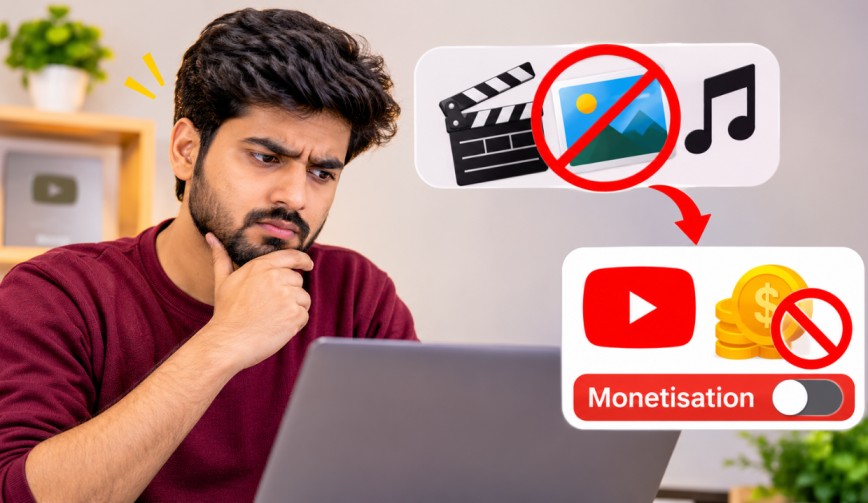
When you upload a video and feel pleased with it, you then receive an email stating that your channel is being reviewed. You’re surprised. Can the YouTube Reused Content Policy result in your channel being demonetised? Yes, it can. If your videos are mainly based on other people’s material and contain only a small amount of your own content, YouTube has the right to take away your ability to earn money. The good news is that this situation is easy to avoid once you know the rules.
What is the YouTube policy regarding reused content?
(Source – OpenAI)
The policy on reusing content on YouTube states that you are not allowed to make money from videos which are mainly composed of other people’s work, such as clips from films or songs, from other creators’ videos, or even from your own videos if you simply re-upload them without making any real changes.
YouTube would like the creators who are part of its YouTube Partner Program (the program which allows you to earn money from advertisements) to provide something new. If viewers can obtain the same thing from the original source, then there is no reason for YouTube to pay you.
Monetisation involves making money from your videos, typically by means of advertisements, memberships, or Super Chat, while demonetisation means that the feature is turned off.
👉Click here to see how Boss Wallah works with brands and what we can build for you
How Reused Content Leads to Demonetisation
It is here that people become confused. The fact that you use someone else’s clip does not immediately put you in trouble. Only when the clip is the entire show and you are merely the one who presses play does any problem arise.
When YouTube examines a channel, it determines if the videos you have uploaded are original or merely copies that have just been given new titles. If the majority of your videos appear to be copies, your channel may have its monetisation taken away. In serious cases, YouTube can even remove you completely from the Partner Program.
It’s similar to a school assignment. The teacher won’t be impressed if you turn in a printed Wikipedia page with your name at the top. On the other hand, if you read it, put your own explanation together, and include your own examples, that would be a different matter.
Read More | Top 10 Influencer Marketing Platforms in India for Brands and Creators.
What is considered to be reused content?
Here are some common examples that can put your channel at risk:
Uploading clips from TV shows or movies with no comments or edits.
Re-uploading another creator’s video, even with a new thumbnail.
Compiling the same viral clips with only a background song added.
Taking a podcast and posting it with a static image and no added value.
Posting reaction videos where you stay silent or barely speak.
The important phrase to keep in mind is ‘transformative content’. That is just a more sophisticated way of saying that you have altered the material sufficiently to give it a new character. You do this by adding your own opinions, your jokes, your lessons, or your personal creative touch.
What can you upload to YouTube?
It’s entirely acceptable to reuse content. Channels that provide reactions, those that publish reviews, news commentaries, and educational explainers all use clips from outside sources and yet manage to earn a good income. The only difference is the value they add.
Here is what helps keep you safe:
Give some real comments: While looking at the clip, talk about it, explain it, make some jokes about it, or criticise it.
Provide useful information: Your video adds value if it helps people learn something new.
Edit with a clear objective: It’s a positive indication when you cut, combine, and rearrange the clips to tell a new story.
Limit yourself to using short extracts: Use only as much as necessary to make your point, not the entire thing.
Certain creators rely on the concept of fair use, which is a legal principle enabling limited use of copyrighted material for purposes such as criticism, reporting the news, and education. However, you should be cautious in this regard since fair use is not a magic protection. YouTube does not have the authority to make the final legal judgments on it. It is a defence that you may have to argue for, not a free licence.
Reused Content vs Copyright Claims
They are frequently confused, but they are in fact different.
A copyright claim is made when the person who owns the material states that you have used their work without permission. YouTube makes use of a system known as Content ID (a tool which automatically scans uploaded videos and compares them with protected content) to detect such cases. Typically, a claim will apply to a single video, and the owner has the option of taking the advertising revenue or blocking the video.
A flag for reused content relates to your entire channel and not to a single video. It indicates that YouTube believes your channel as a whole does not provide sufficient original value. Therefore, it’s possible for you to have no copyright claims at all and yet still lose your ability to monetise. It’s funny how that works.
How to Protect Your Channel from Demonetisation
You don’t have to become a film director. A few simple habits make a big difference:
Make use of a voiceover: Even a brief and genuine one makes your video your own.
Add your own footage: Include screen recordings, photographs, and spoken segments.
Make your point clear: Consider whether the viewer gains anything from your video that they wouldn’t already get from the original.
Give proper credit: Acknowledgement does not resolve the policy issue, but it demonstrates good faith.
Look through your earlier videos: Previously uploaded videos can have an adverse effect on you. Either delete or alter the ones that are poor.
Occasionally check YouTube’s updates: The rules do change, and it only takes a few minutes to stay informed.
What to Do If You Get Flagged
(Source – OpenAI)
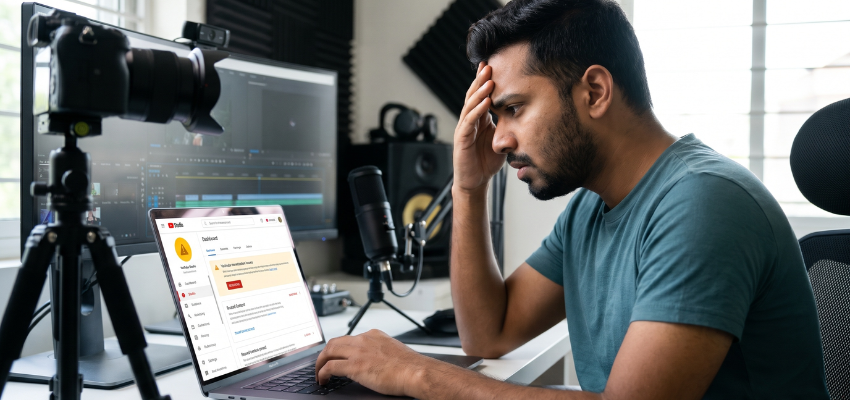
Don’t panic in the first place. Take the time to read the email since it usually specifies the problem. You should then correct the issue by either removing the flagged videos or improving them.
Once you’ve done that, you can apply for a new review, although you might have to wait before you can do so.
When you resubmit, ensure that your most recent uploads demonstrate genuine effort and originality. YouTube wants to see a pattern of improvement, not just a one-day fix.
Read More | Tier 3 Creators and Brand Collaborations: Why Smaller Cities Deserve More Attention.
Need Videos, Creators, or Regional Content for Your Brand?
Boss Wallah helps brands plan and execute video content at scale, without managing multiple vendors.
We work with companies to:
- Shoot large volumes of short-form videos using real creators and studio setups, suitable for social media, websites, campaigns, and launches
- Adapt the same videos for different languages, regions, and platforms, so one shoot works across India and global markets
- Launch products or campaigns through dozens or hundreds of creators, all managed, tracked, and reported in one system
- Support brands with ongoing content, launches, regional expansion, and performance-focused campaigns
Whether you need videos for a new launch, content for multiple markets, creator-led visibility, or a steady content pipeline, Boss Wallah acts as a single partner handling production, creators, and execution end-to-end.
👉Click here to see how Boss Wallah works with brands and what we can build for you
Final Thoughts
Well, will the policy regarding the reuse of content have a negative effect on your earnings? Yes, but only in the case where your channel relies on other people’s work without putting in anything original. If you have your own voice, your own ideas, and a bit of personality, then you’ll be in a good position. Your viewers will also enjoy your videos more, which is the real advantage.
Frequently Asked Questions
1. Will I be able to make money if I use movie clips in my YouTube videos?
Certainly, but only in the case of short clips, and only if you include substantial commentary, analysis, or educational content. Otherwise, clips that provide no additional value may result in demonetisation or a copyright claim.
2. Is reused content equivalent to a copyright strike?
Not at all. A copyright strike relates to permission to use particular material, while a reused content flag has to do with whether your channel provides sufficient original value. It is possible to encounter one without the other.
3. Is it possible for me to re-upload some of my previous videos?
Although you can do this, if the video is not altered, YouTube might consider it to be repeated content. Ensure that the new version includes updates, additional information, or has a distinct new purpose.
4. How long before you get monetisation again?
It depends. Once you’ve revised your content, you can ask for a review, and the length of time you have to wait is up to YouTube. Since many creators have to wait a few weeks or even longer, you should continue to upload original videos during that time.
5. Should reaction videos be considered as reused content?
You can do this as long as you say very little. A reaction video that shows your genuine thoughts, jokes, and insights is far safer than one that simply plays the original clip.