Is Performance Marketing the Same as SEO? Here Are 7 Key Differences That Brands Should Know

Is performance marketing the same as SEO? If you’ve ever posed that question in a meeting and seen three people nodding while appearing a bit confused, then you’re not the only one. Both aspects should be included in a solid digital marketing strategy since both assist in getting people to find your brand on the internet. However, they function in very different ways. Let’s sort this out without causing you any distress.
Is Performance Marketing the Same as SEO? The Brief Answer
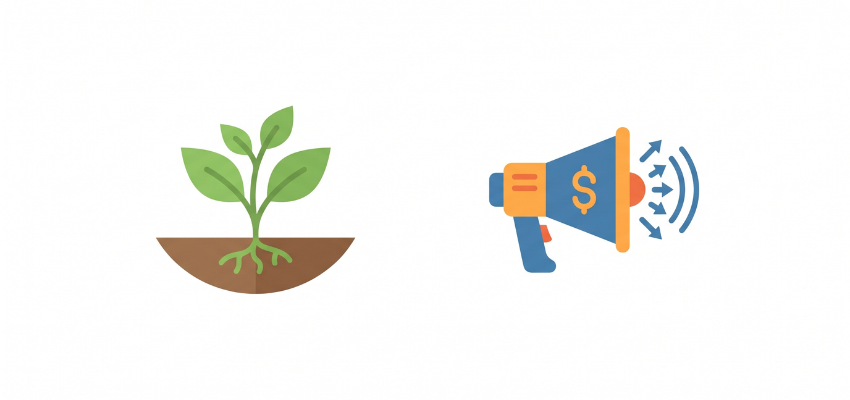
(Source – OpenAI)
SEO is similar to growing a vegetable garden in that it requires a lot of time and regular watering, but eventually you end up with free food. With performance marketing, it’s like ordering from a restaurant since you get your food quickly but have to pay each time.
A Quick Look at Each One
Performance marketing is a type of advertising in which you pay for specific results or actions, such as clicks, sign-ups, or sales. It is generally carried out through paid ads on Google, Instagram, and Facebook.
SEO is an abbreviation for search engine optimisation. It refers to the process of improving your website so that Google displays it higher in search results without requiring you to pay for each visit. Visitors who find your site this way are known as organic traffic, which simply means people who discover your website naturally through search engines.
👉Click here to see how Boss Wallah works with brands and what we can build for you
7 Key Differences Brands Should Know
Let me start with a quick overview. The details follow shortly after.
| No. | Difference | Performance Marketing | SEO |
|---|---|---|---|
| 1 | How you pay | Pay for specific results or actions | Pay for the work, not the clicks |
| 2 | Speed | Hours to days | Several months |
| 3 | Lasting power | Stops when the budget ends | Can last for years |
| 4 | Cost over time | Can rise with competition | Cost per visitor can decrease |
| 5 | Control | High | Lower |
| 6 | Measurement | Clicks, sales, ROAS | Rankings, organic visits |
| 7 | Main goal | Quick leads and sales | Steady growth and trust |
1. How You Pay
In performance marketing, you pay for specific actions. A typical example is pay-per-click (PPC), which means you are charged whenever someone clicks on your ad.
With SEO, on the other hand, you pay for the work involved, such as writing content, improving website pages, and fixing technical issues.
2. The Speed at Which You Will See Results
Performance marketing is the sprinter. If you launch a campaign today, you could start seeing visitors within hours.
SEO, on the other hand, is like a marathon runner. It generally takes several months to see meaningful results, depending on your website, competition, and strategy. Anyone who promises guaranteed SEO results immediately is probably selling something else as well.
3. The Duration of Results
Once your advertising budget runs out, traffic from your paid campaigns usually stops, just as if you had turned off a tap.
With SEO, it’s more like a well that continues to fill up. A useful, well-optimised article can attract visitors for years, provided it remains relevant and maintains its search visibility.
Read More | Influencer Marketing vs Video Ads for Performance Marketing: What Actually Scales?
4. Cost Over Time
As competition increases and more brands target the same audience, advertising costs can rise. SEO requires effort and investment at the beginning, but the cost per visitor may decrease as your content grows and attracts more organic traffic over time.
This can help your marketing budget go further in the long run.
5. Level of Control
With paid advertising, you can decide:
- Which audience sees your ads.
- When your ads appear.
- How much you want to spend.
- When to pause or stop a campaign.
With SEO, results are less predictable because Google determines search rankings based on its ranking systems, which can change over time.
6. The Way You Measure Success
Performance marketing and SEO both use data to measure results, but the metrics differ.
For performance marketing, you can track:
- Clicks: How many people click on your ads.
- Sales and leads: How many people complete your desired action.
- ROAS: Return on ad spend, which measures how much revenue you generate for every unit of money spent on advertising.
SEO is usually assessed through:
- Search rankings: Where your pages appear in search results.
- Organic traffic: How many visitors find your website through unpaid search results.
- Conversion rate: The proportion of visitors who complete your desired action, such as signing up or making a purchase.
7. The Main Goal
Performance marketing focuses on achieving quick, measurable results, such as generating leads, increasing sales, or attracting customers through paid campaigns.
SEO, on the other hand, aims to build long-term visibility, increase brand awareness, and help people discover and trust your brand.
One can help bring customers into your shop this week, while the other can help people find your business months or even years later.
Then, Which of the Two Should Your Brand Select?

(Source – OpenAI)
You don’t necessarily need to choose one approach. The smartest brands often use both.
- Choose performance marketing if your goal is to generate sales quickly, promote a new product, or test an offer.
- Choose SEO if you want to build organic traffic, improve search visibility, and support long-term growth.
- Combine both if you want to attract customers now while building a sustainable source of traffic for the future.
There’s a useful trick. When a keyword (a word or phrase people enter into Google) drives traffic to your ads, create useful content around it. In this way, your ads can act as a testing ground for discovering what your audience wants.
Also, remember to keep an eye on your landing page, which is the page a visitor sees after clicking on your ad or search result. If it’s confusing or difficult to navigate, it can waste both your advertising money and your SEO efforts.
Make sure the page is clear, loads quickly, and focuses on one main action.
Read More | Why Video Production Companies in India Struggle with Performance Marketing Ads.
Need Videos, Creators, or Regional Content for Your Brand?
Boss Wallah helps brands plan and execute video content at scale, without managing multiple vendors.
We work with companies to:
- Shoot large volumes of short-form videos using real creators and studio setups, suitable for social media, websites, campaigns, and launches
- Adapt the same videos for different languages, regions, and platforms, so one shoot works across India and global markets
- Launch products or campaigns through dozens or hundreds of creators, all managed, tracked, and reported in one system
- Support brands with ongoing content, launches, regional expansion, and performance-focused campaigns
Whether you need videos for a new launch, content for multiple markets, creator-led visibility, or a steady content pipeline, Boss Wallah acts as a single partner handling production, creators, and execution end-to-end.
👉Click here to see how Boss Wallah works with brands and what we can build for you
Final Thoughts
Well, is performance marketing the same as SEO? You now know that the answer is a definite no, but the two work very well together.
Use paid advertising for quicker results and SEO for long-term growth. Track your performance, learn what works, and adjust your strategy as needed. Your marketing budget will appreciate it.
Frequently Asked Questions
1. Does Performance Marketing Outperform SEO?
Neither one wins every single time. Advertising is useful for achieving quick results, while SEO is better suited to building long-term organic visibility. Your goals, budget, audience, and timeline will determine which approach works best.
2. Can Small Businesses Use Both as Well?
Certainly. Small businesses can launch a modest advertising campaign to attract early customers while gradually creating useful SEO content. This approach helps balance immediate needs with future growth.
3. Can SEO Be Classified as a Form of Performance Marketing?
Not typically. Performance marketing usually refers to paid campaigns focused on measurable actions, whereas SEO is an organic marketing channel. However, both can be measured against business goals.
4. What Is the Time Taken by SEO Compared to Paid Ads?
Paid ads can start attracting visitors within hours of a campaign going live, while SEO generally takes several months to deliver meaningful results. The actual timeline depends on competition, website quality, and the strategy used.
5. Which of Them Provides a Better Return on Investment?
Paid ads can generate results quickly, and their performance is relatively easy to measure. SEO may provide stronger long-term value because well-performing pages can continue attracting organic traffic without a charge for every click. The better return depends on your business goals, costs, and conversion rates.