YouTube Search vs Suggested Videos: Where Should Creators Focus?
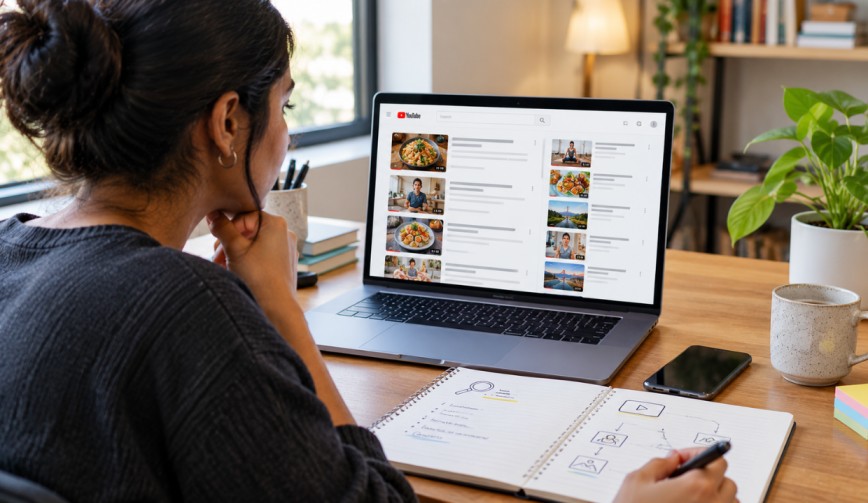
If you’ve ever opened your analytics and thought to yourself, “Should You Focus On YouTube Search Or Suggested Videos?”, then you’re in good company. All content creators at some stage ask this question, typically at 11 p.m., while holding a cold cup of tea and questioning their life decisions. The good news is that the solution is simpler than it appears. Let’s look at it in more detail.
What does YouTube search traffic entail?

(Source – OpenAI)
Search traffic refers to the group of people who discover your video by entering a query into the YouTube search bar. For example, a person who is looking for a way to fix a leaking tap types the query into the search bar and your video then appears.
The most important point to grasp in this situation is viewer intent, i.e. what the individual actually wants. Since these viewers know exactly what they’re looking for, they aren’t browsing just for amusement. They’re on a mission, and if your video addresses their problem, then they’ll stay.
👉Click here to see how Boss Wallah works with brands and what we can build for you
What Are Suggested Videos?
The videos that are suggested are the clips that YouTube recommends in the sidebar when you are watching a video or on the home page; no one has searched for them. YouTube has just guessed that the viewer might like them.
Imagine a friend saying, “You liked that film, haven’t you? Then you’re going to love this one.” In this case, the YouTube algorithm, being the set of rules that YouTube uses to determine what to show each user, acts exactly like that friend and looks at the films people have watched in the past in order to keep them on the site.
Why Search Is Great for New Channels
For a small channel, search is generally your best ally since you don’t need thousands of subscribers for it to be effective; all you need is a video that corresponds with what someone is typing.
Here is why search is so helpful:
- It provides you with continuous traffic over time since people continue to search for the same things.
- It suits evergreen content, that is to say videos which remain useful for many years, such as “how to boil an egg” or “beginner budgeting tips”.
- It enables you to discover precisely what your audience wants, as you can see the terms they use.
If you want to succeed in this area, you should carry out basic video SEO, which is simply a matter of arranging your video so that YouTube knows what it’s about. Include clear keywords, the words that people actually type, in the title, the description, and the spoken script. Make sure your title is honest and easy to understand. There’s no need to cram it in the way you’d stuff a holiday turkey.
Read More | YouTube New Monetisation Rules: From Shorts to Monetisation, What’s New?
Why Suggested Videos Can Make You Explode
The number of searches remains steady, but it’s among the suggestions that the big increases occur. Your views can rise very quickly when YouTube begins to recommend your video to thousands of other people.
As a channel develops, suggested traffic usually becomes the main source. The reason for this is that there are only a limited number of people who search for your topic, whereas there is a much larger group of people who would enjoy it if the content were shown to them.
The videos that are recommended to you depend a great deal on how people respond to your content. YouTube looks at a number of important signals:
- Click-through rate, commonly referred to as CTR, is the percentage of individuals who click on your video after having seen it. For example, if 100 people view your thumbnails and 8 of them click, then your CTR will be 8 per cent.
- Watch time refers to the total amount of time that people spend watching your video.
- Audience retention is the measure of how much of your video your audience actually watches before quitting.
When viewers click on it and remain watching, YouTube interprets this as a sign that people do like it and therefore shows the video to more people.
Where should creators direct their focus, between YouTube Search and Suggested Videos?
That’s the straightforward answer: it all comes down to where your channel is at the moment.
- If you’re only just beginning, concentrate on search. Since you don’t have any history with the algorithm, it doesn’t know which people to show your videos to. With search, you can get in front of those people who are already looking for the things you provide. It’s similar to opening a small shop on a busy street rather than hoping that someone will wander into your back alley.
- If you’ve already got some progress, pay more attention to the suggested videos. When you have a few videos that are performing well, YouTube will have gathered enough data about your audience to recommend you to similar viewers.
- To achieve long-term growth, do both, since they are not rivals but, in fact, complement one another. Search drives traffic to your channel, and if the viewers enjoy your content, YouTube then suggests your other videos to them. That is what real YouTube channel growth looks like.
Simple Ways to Improve Both

(Source – OpenAI)
You don’t need any special equipment; a couple of little habits make a big difference.
- Before you start filming, type your topic into the YouTube search bar and look at the suggestions it offers; those are actual searches carried out by real people.
- Make your first 30 seconds count. Tell viewers exactly what they’ll get and then give it to them. Going on at length with a tedious introduction is the quickest way of losing your audience.
- Make sure your thumbnails are clear by using a simple image, a few bold words, and a face if appropriate. If a thumbnail can’t be understood on a phone screen, then it is too cluttered.
- Connect the videos that are related. In your script, refer to your other videos and use end screens; this encourages viewers to continue watching you rather than going to another channel.
- Look at the analytics. In YouTube Studio, open the traffic source report since it displays the number of views that come from search and the number that come from suggested videos. Let the figures lead you rather than making guesses.
A Quick Word of Caution
Don’t focus so much on a single source that you lose sight of the viewer. A title full of keywords but with a dull video won’t be of any use to you. A showy thumbnail that offers no real reward will damage your watch time. If you produce something that is genuinely useful or entertaining, then the other aspects will become a lot easier.
Read More | YouTube UGC Ads: When Your Ad Feels More Like a Real YouTube Video.
Need Videos, Creators, or Regional Content for Your Brand?
Boss Wallah helps brands plan and execute video content at scale, without managing multiple vendors.
We work with companies to:
- Shoot large volumes of short-form videos using real creators and studio setups, suitable for social media, websites, campaigns, and launches
- Adapt the same videos for different languages, regions, and platforms, so one shoot works across India and global markets
- Launch products or campaigns through dozens or hundreds of creators, all managed, tracked, and reported in one system
- Support brands with ongoing content, launches, regional expansion, and performance-focused campaigns
Whether you need videos for a new launch, content for multiple markets, creator-led visibility, or a steady content pipeline, Boss Wallah acts as a single partner handling production, creators, and execution end-to-end.
👉Click here to see how Boss Wallah works with brands and what we can build for you
Final Thoughts
People can discover your channel through search, and suggested videos help people continue to find you. If you’re just starting out, begin with search and as your channel develops, shift towards using the suggested videos, treating both of them as teammates. You should be patient, keep on learning, and have fun with the process. Even large channels initially had only ten views, and at least three of those came from their mother.
FAQs
1. Do search or suggested videos generate more views?
In small channels, searches generally yield more results, while in larger channels, the suggested videos take over since the algorithm has more data to work on.
2. Is it possible for me to gain popularity on YouTube without appearing in search results?
Certainly, although many channels rely primarily on suggested videos and the browse features, search provides a reliable foundation, which is why it is sensible not to ignore it.
3. What constitutes a good click-through rate on YouTube?
The CTR for most channels is between 2 and 10 per cent; this depends on the topic and the audience, so it’s best to compare your own past videos with one another rather than with those of other creators.
4. What time do videos take to appear in search?
The time involved can range from a few days to a few weeks; some videos achieve high rankings quickly, whereas others rise slowly as more people watch and interact with them.
5. Does it matter for both traffic sources whether thumbnails and titles are used?
Certainly. In the search function, they assist people in selecting your video from a list, and in the suggested section, they determine whether a person will click at all. Both in search and in the suggested feature, a clear title and a simple thumbnail are helpful.