Social Media KPIs: Your Dashboard Is Full, But What Should You Actually Track?
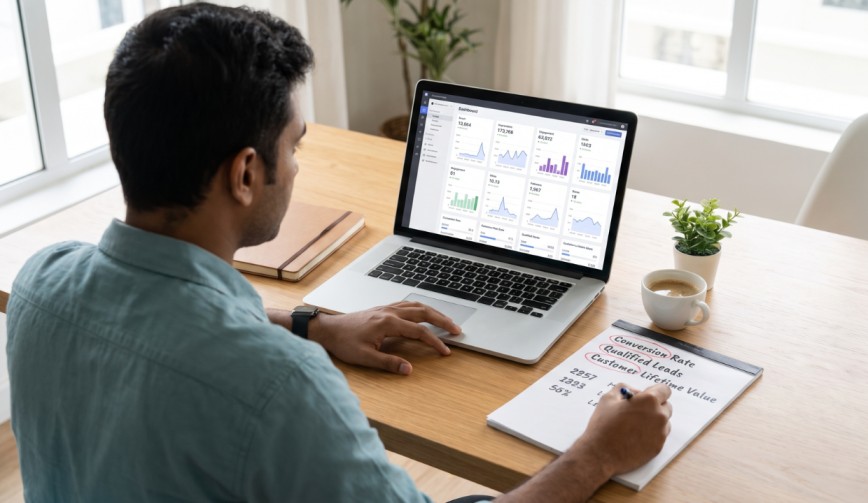
Your social media dashboard is full of numbers. Likes are up, followers are up, and one of your posts has received thousands of views. All very good! But the real question is, is any of that contributing to the growth of your business?
Social Media KPIs help you understand which activities are working, which are wasting your time, and what you need to improve. Instead of monitoring every number you see, focus on the KPIs that connect your social media activity to tangible results.
What Are Social Media KPIs?

(Source – OpenAI)
KPI stands for Key Performance Indicator. In simple terms, it is a number you use to measure whether you are achieving your objective.
- If your objective is to boost brand awareness, reach and impressions are useful metrics.
- If you want more sales, website clicks and conversions are the metrics you should focus on.
Social media metrics are measurable figures, such as likes, comments, shares, and views. KPIs are the specific metrics you choose to measure progress towards your objectives.
Think of it this way: you can count every step you take, but if you are trying to reach a destination, you also need to know whether you are moving in the right direction.
👉Click here to see how Boss Wallah works with brands and what we can build for you
7 Social Media KPIs You Should Track
You don’t need a dashboard with 50 metrics on it. Start with these seven KPIs and choose the ones that are relevant to your objectives.
1. Reach: How Many People See Your Content?
Reach tells you how many unique accounts have seen your content. It indicates whether your content is reaching new people or is primarily being seen by your existing audience.
- When to track it: When your objective is brand awareness or reaching a wider audience.
- What to improve: Experiment with content formats, topics, and different posting times. If your reach remains low, ask yourself whether your content is giving people a reason to stop scrolling.
2. Engagement Rate: Are People Actually Interested?
Likes look pretty good on the surface, but engagement tells you more about how people are responding to your content. Engagement includes the actions people take, such as likes, comments, shares, and saves.
Your social media engagement rate measures interactions with your content relative to your audience or reach, depending on the formula you use.
A simple formula is:
Engagement rate by reach = (Total engagements ÷ Reach) × 100
For example, if a post reaches 2,000 accounts and receives 100 engagements, its engagement rate by reach is 5%.
- When to track it: When you want to know whether your content connects with your audience.
- What to improve: Create content that encourages people to comment, save, and share.
3. Follower Growth: Is Your Audience Growing?
Your follower count tells you how many people follow your account. However, it doesn’t tell you how quickly your audience is growing or whether those followers are genuinely interested in your content.
Track your follower growth rate to understand how your audience is developing over time.
- When to track it: When building a community or increasing your brand’s visibility is the objective.
- What to improve: Share content that appeals to your target audience and gives people a reason to follow you.
4. Click-Through Rate: Are People Taking the Next Step?
A post can easily receive thousands of views. That’s of little use if nobody clicks your link.
Click-through rate (CTR) is the percentage of people who click a link after seeing it. The exact calculation varies depending on the platform and the click data available.
- When to track it: When promoting a blog post, product page, landing page, or registration form.
- What to improve: Use clear calls to action (CTAs), which are prompts that tell people what to do next. For example, “Read the guide” is more specific than “Learn more about us”.
5. Conversion Rate: Are Clicks Turning Into Results?
Clicks are useful, but what happens after someone visits your website?
Social media conversion rate measures how many people complete a desired action after arriving through your social media activity. That action could be a purchase, sign-up, or enquiry.
- When to track it: When your objective is lead generation, sales, or registrations.
- What to improve: Make sure your landing page delivers on the promise of your post. If your post promotes a discount, your landing page should make that discount obvious and easy to find. Visitors shouldn’t have to search the entire website for it.
6. Shares and Saves: Is Your Content Worth Keeping?
Shares indicate that people want others to see your content. Saves suggest that they want to return to it later.
These are particularly useful for tutorials, checklists, practical tips, and educational posts.
- When to track them: When you want to create content that people find useful enough to share or revisit.
- What to improve: Focus on content that solves a problem, answers a common question, or makes a difficult task easier.
7. Customer Response Time: How Quickly Do You Reply?
Social media isn’t just a publishing platform. It’s also a place where customers ask questions, raise concerns, and enquire about products.
Customer response time measures how long your team takes to respond to messages and comments that require a reply.
- When to track it: When customer support and relationship building are important business goals.
- What to improve:
- Set a reasonable response time.
- Assign someone to monitor incoming messages and comments.
- Prepare answers to frequently asked questions.
- Make sure customers aren’t left waiting three days just to find out whether a product is in stock.
Read More | Micro Influencer Rates in India: How Much Should You Pay?
How to Choose the Right Social Media KPIs for Your Goals
The easiest way to avoid tracking too many numbers is to start with your business objective.
| Your goal | KPIs to prioritise |
|---|---|
| Build brand awareness | Reach, impressions, follower growth |
| Increase engagement | Engagement rate, shares, saves |
| Drive website traffic | Link clicks, click-through rate |
| Generate leads or sales | Conversion rate, leads, sales |
| Improve customer support | Response time, response rate |
Pick around three to five KPIs for each campaign or reporting period. You can always look at other metrics when needed, but your main dashboard should make the most important results obvious.
Also, review performance over time. A post that receives 500 clicks this month might seem successful, but the number becomes more meaningful when you compare it with previous months.
Common Mistakes to Avoid When Tracking Social Media KPIs

(Source – OpenAI)
A structured dashboard can still lead you in the wrong direction if you’re tracking the wrong metrics.
Watch out for these common mistakes:
- Chasing vanity metrics: Large follower counts and plenty of likes can look impressive without producing meaningful business results.
- Tracking everything: Too many numbers make it difficult to identify what actually matters.
- Comparing platforms incorrectly: Instagram, LinkedIn, and YouTube measure activity differently. Compare similar metrics and consider the purpose of each platform.
- Ignoring business goals: A post isn’t automatically successful just because it performs well. It should support your broader objective.
- Making decisions too quickly: One underperforming post doesn’t mean your entire strategy has failed. Look for patterns across multiple posts and reporting periods before making major changes.
Read More | Beyond Views and Likes: How to Measure Creator Campaign Impact.
Need Videos, Creators, or Regional Content for Your Brand?
Boss Wallah helps brands plan and execute video content at scale, without managing multiple vendors.
We work with companies to:
- Shoot large volumes of short-form videos using real creators and studio setups, suitable for social media, websites, campaigns, and launches
- Adapt the same videos for different languages, regions, and platforms, so one shoot works across India and global markets
- Launch products or campaigns through dozens or hundreds of creators, all managed, tracked, and reported in one system
- Support brands with ongoing content, launches, regional expansion, and performance-focused campaigns
Whether you need videos for a new launch, content for multiple markets, creator-led visibility, or a steady content pipeline, Boss Wallah acts as a single partner handling production, creators, and execution end-to-end.
👉Click here to see how Boss Wallah works with brands and what we can build for you
Final Thoughts
Your social media dashboard should help you make decisions, not give you more numbers to worry about. The KPIs you track will depend on your objectives, whether that’s reaching new audiences, building engagement, generating leads, or improving customer support.
Start by reviewing your results regularly and use what you learn to improve your content. The goal isn’t to have the biggest dashboard. It’s to understand what’s working and why.
Frequently Asked Questions
1. What Are the Most Important Social Media KPIs?
The most important KPIs depend on your goals. Reach and impressions help measure awareness, engagement rate measures audience interaction, and click-through rate and conversions help track website traffic and business results.
2. How Many Social Media KPIs Should I Track?
Start with three to five KPIs for each campaign or reporting period. Add more metrics only when they help you answer a specific question about performance.
3. What Is the Difference Between Social Media Metrics and KPIs?
Metrics are figures such as likes, views, and comments. KPIs are the specific metrics you select to measure progress towards a business goal.
4. How Often Should I Review My Social Media KPIs?
Review performance weekly if you need to make content adjustments. Prepare monthly reports to identify broader trends. For active campaigns, you may need to check results more frequently.
5. Which Social Media KPIs Are Best for Small Businesses?
Small businesses can start with reach, engagement rate, link clicks, enquiries, and conversions. Choose the measures that connect directly to your business goals rather than tracking every available number.