AI-Generated UGC vs Human UGC: When AI-Generated UGC Feels Too Perfect for Real People

User-generated content has never been about appearing perfect; on the contrary, that is usually the main idea. The main difference when comparing AI-generated UGC with human UGC isn’t always the camera quality or the editing. It’s rather the degree to which the content seems genuine. Although AI-generated videos can appear well-polished, clear, and almost excessively neat, human UGC usually has small flaws that cause people to trust it.
This situation raises an interesting question for brands: since AI can produce videos in the style of user-generated content quickly, should all brands do so? Or does it become pointless to make content look too perfect, since that’s exactly what people liked about user-generated content initially?
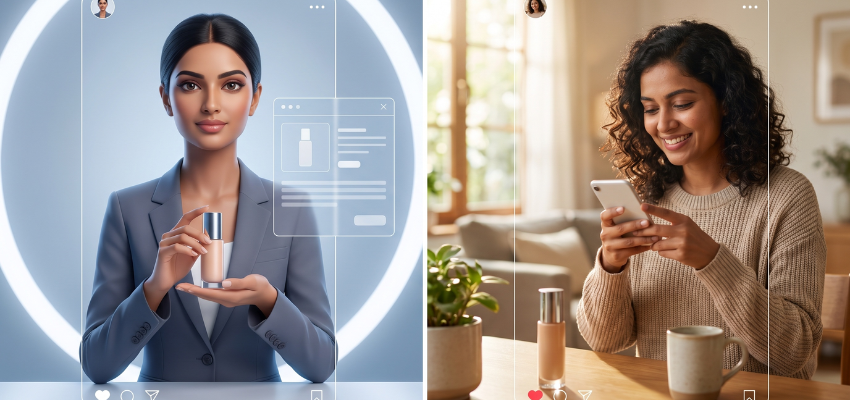
What’s the Difference Between AI-Generated User-Generated Content and Human-Generated User-Generated Content?
(Source – OpenAI)
AI-generated user-created content is content that is produced with the aid of artificial intelligence; it can involve AI-generated people, voices, scripts, product demonstrations, or entire videos that appear as if they are ordinary customer content.
Human user-generated content is produced by real people; for example, a customer might share their experience, a creator might demonstrate how they use a product, or someone might talk about something that they actually like.
Both can be useful; the difference lies in the feeling.
| AI-Generated UGC | Human UGC |
|---|---|
| Can be created quickly | Takes time to create |
| Often looks polished | Can look more natural |
| Easy to create different versions | Each creator has their own style |
| Useful for testing ideas | Useful for sharing real experiences |
| May feel too scripted or perfect | Can include natural reactions and imperfections |
👉Click here to see how Boss Wallah works with brands and what we can build for you
Why Does UGC Created by AI Sometimes Seem Too Perfect?
It is now very easy for people to recognise content that sounds excessively refined.
A digitally generated person might have perfect lighting, smoothly perfected skin, a carefully managed background, and a voice that sounds as if it’s a bit too clean. There’s nothing technically incorrect about it, but it’s still possible that it seems off.
Imagine it this way: if a friend sends you a short video of their kitchen, you wouldn’t mind if there was a packet on the counter.
You might begin to question what it is that is being sold if a video appears to have taken someone three hours to get their kitchen looking perfect before they say a single sentence about a product.
It is in this area that AI-generated user content can occasionally lack a natural quality.
Human UGC Has Small Imperfections
One reason human UGC works is that it does not always seem like an ad.
A person could put forward their point of view in their own words rather than quoting a perfectly written script; they might demonstrate the way in which they actually use a product, and they might even mention something that they didn’t like.
Including these small details can make the content seem more genuine.
For instance, when a skincare brand says, “I liked it, but it did take me a few days to get used to the fragrance,” it sounds more believable than a well-written statement such as “This product completely transformed my routine.”
Real people aren’t always like advertisements, which is their strength.
Read More | UGC Content Licensing and Why Real Customers Can Build More Trust.
When AI UGC Can Still Work Well
That doesn’t mean that UGC produced by AI is automatically bad.
AI is useful in cases where brands need to:
- Produce content rapidly
- Evaluate various ideas
- Make several versions of a video
- Try out different hooks, scripts, and formats
- Test content before committing to bigger creator campaigns
For instance, a brand might use artificial intelligence to evaluate various opening lines for a product video. If one of the versions receives higher engagement, the brand could then collaborate with an actual creator to produce a more natural version.
Trouble arises when AI is used merely to mimic human experiences without taking into account whether the audience will believe them.
The Trust Problem With AI-Generated UGC
Trust is an important element in UGC marketing.
People often think that a person has used a product when they see that a real customer or creator is talking about it; with content produced by AI, that assumption is less valid.
This is particularly important in the case of products where personal experience plays a role.
One might wish to see:
- How a makeup product appears on actual skin
- How a fitness product fits into a person’s routine
- How a business tool functions in reality
AI can make it look as though an experience has taken place, while a real person can actually share the experience.
That makes a significant difference.
Should Brands Opt for AI or Human-Generated User Content?
It doesn’t have to be one or the other every time.
AI-generated content may be used by brands for:
- Testing
- Creating content variations
- Conducting creative experiments
- Achieving faster production
Human user-generated content can be useful when:
- Trust is important
- Personal experience matters
- Genuine reactions are needed
The essential point is understanding the purpose that the content is meant to serve.
An AI might be suitable when the aim is to get through something quickly.
Human user-generated content might have the benefit of making people think, “Someone like me actually uses this.”
An effective UGC strategy could include both options, rather than viewing AI as a substitute for real people.
Read More | What Is UGC and How Does BossWallah Build a Brand’s UGC Pipeline?
The Future of UGC May Be Less Perfect

(Source – OpenAI)
What’s interesting about AI is that it makes content appear more realistic at the same time as making people doubt whether it actually is real.
It therefore means that brands might have to give up on pursuing perfection.
Sometimes, a bit of a disorderly background, a natural pause, or a creator expressing themselves in their own words can achieve more in a video than perfect lighting and flawless editing.
The real issue when comparing AI-generated user-generated content with human-generated UGC is not which appears better.
It is the one which the audience finds believable.
At times, the most convincing content is that which appears to have been produced by a real person since it actually was made by one.
Need Videos, Creators, or Regional Content for Your Brand?
Boss Wallah helps brands plan and execute video content at scale, without managing multiple vendors.
We work with companies to:
- Shoot large volumes of short-form videos using real creators and studio setups, suitable for social media, websites, campaigns, and launches
- Adapt the same videos for different languages, regions, and platforms, so one shoot works across India and global markets
- Launch products or campaigns through dozens or hundreds of creators, all managed, tracked, and reported in one system
- Support brands with ongoing content, launches, regional expansion, and performance-focused campaigns
Whether you need videos for a new launch, content for multiple markets, creator-led visibility, or a steady content pipeline, Boss Wallah acts as a single partner handling production, creators, and execution end-to-end.
👉Click here to see how Boss Wallah works with brands and what we can build for you
Final Thoughts
AI is altering the way that brands produce user-generated content, yet it doesn’t take away the value of real people.
AI-generated user-generated content can:
- Save time
- Aid in the testing process
- Help brands explore new creative ideas
Human-generated content, on the other hand, provides something that is more difficult to produce:
- Genuine experiences
- Spontaneous reactions
- Personal opinions
It is not necessary for brands to opt for perfection instead of authenticity; a wiser strategy would be to know the situations in which each kind of content is appropriate.
It’s because when all the videos appear perfectly edited, a small amount of realism is actually what causes people to stop scrolling.
FAQs
1. What Is UGC That Has Been Generated by AI?
AI-generated user-created content is content that has been produced using artificial intelligence in such a way as to appear as if it had been generated by users. It may involve AI-created people, voices, scripts, images, or videos.
2. Does User-Generated Content That Is Human-Created Prove to Be Better Than User-Generated Content That Is Produced by AI?
One is not inherently superior; human user-generated content may seem more personal and genuine, while AI-generated content allows brands to produce content more quickly and test a greater number of ideas.
3. Why Does UGC Created by AI Seem Unnatural?
It may on certain occasions appear excessively polished, pre-written, or perfect; small flaws found in human-created material can make it seem more familiar and realistic.
4. May Brands Make Use of Both AI and Human UGC?
Certainly. Artificial intelligence can be used for testing and for varying content when actual creators or customers are being used because personal experience and trust are important.
5. Will Artificial Intelligence Take the Place of Human User-Generated Content?
Even though AI may affect the way user-generated content is created, it does not entirely remove the value of genuine experiences, opinions, and reactions from customers and creators.