Brand Collaboration Rates Made Simple: A Beginner’s Guide for Creators

So you just got your first message from a brand saying “Hi, we love your content, let’s work together!” Exciting, right? Then comes the one question that turns most creators into a nervous wreck: “What are your rates?”
Cue the panic sweat.
Most creators either say yes to free stuff and end up working for nothing, or they throw out a random big number and hope for the best. A discount code is not real payment, and we need to talk about that. Neither of these approaches works for long. What you actually need is a simple way to understand your brand collaboration rates, so you can share a number with confidence instead of typing it, deleting it, and typing it again ten times.
What Are Brand Collaboration Rates, Really?

(Source – applabx.com)
In simple words, brand collaboration rates are the price you charge a brand when you create content to promote their product. This could be an Instagram post, a YouTube video, a blog, or even a quick story mention.
Think of yourself as a small business. A brand is not just paying for one photo or video. They are paying for your time, your creativity, your editing skills, and most importantly, the trust your audience has in you. That trust took months or years to build, so it deserves a fair price. This is also called influencer pricing, and it works the same way whether you have 2,000 followers or 2 million.
👉Click here to see how Boss Wallah works with brands and what we can build for you
Why Pricing Feels So Confusing
Most of us did not take a business class before becoming creators. We picked up a phone camera, started posting, and slowly grew an audience. Nobody handed us a price list.
The good news is that once you understand a few simple ideas, setting your content creator rates becomes much easier. It turns into simple math instead of a scary guessing game.
What Affects Your Rates
Before deciding a number, you need to know what actually changes the price. These factors decide whether you charge a little or a lot.
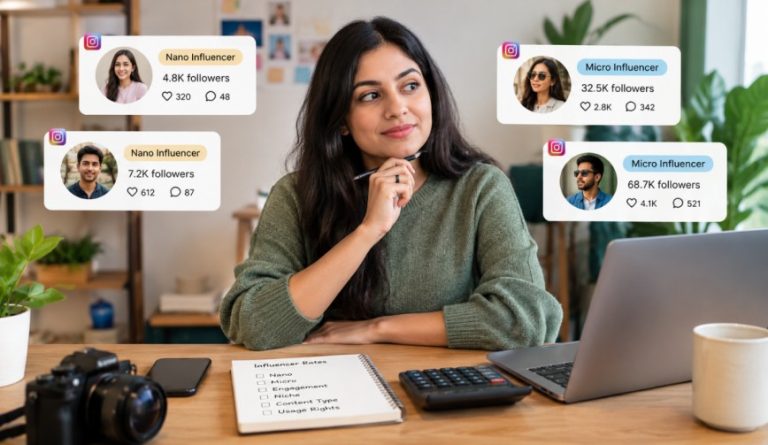
- Follower count and engagement rate: Followers matter, but engagement rate matters even more. Engagement rate means how many people actually like, comment, share, or save your posts. A creator with 10,000 followers who get a lot of likes can earn more than someone with 50,000 followers who get very few likes.
- Platform: A YouTube video usually takes more time and effort than an Instagram reel, so it often costs more. A blog post with good SEO value can also earn well because it keeps working for the brand long after it is published.
- Type of content: A single photo is priced differently than a full video with scripting, filming, and editing. More effort should always mean more money.
- Usage rights: This means how and where the brand can use your content after you make it. If they only post it once on their own page, that is a small ask. If they want to run it as a paid ad or use it for a whole year, that is a much bigger ask and should cost more.
- Exclusivity: Sometimes a brand asks you not to work with similar brands for a certain time. This is called an exclusivity clause, and it should always come with extra payment since it limits your other income.
- Niche: Some niches like finance, tech, and beauty usually pay more because those brands have bigger marketing budgets.
Read More | How to Nail Your First Brand Collaboration Effortlessly.
Simple Ways to Calculate Your Rate
Now for the part everyone actually wants to know, how do you turn all this into one clear number?
The CPM Method
CPM stands for cost per thousand impressions. The “M” comes from the Roman number for one thousand. You decide how much you want to earn for every 1,000 people who see your content, then multiply that by your average reach.
For example, if you want 10 dollars for every 1,000 views, and your post usually gets 20,000 views, your rate would be 200 dollars for that content. Simple multiplication, no confusion.
The Flat Rate Method
Here, you set one fixed price for each type of content. For example, one price for a reel, another for a carousel post, and another for a YouTube integration. This makes quoting fast and easy once you know your worth.
The Package Method
This means bundling multiple deliverables together, like one reel plus three stories, and offering it as a package deal. It usually costs a little less than buying each item separately, but you still earn a bigger total amount in one go.
Here is a simple table to help you understand how pricing can look for a small creator just starting out:
| Content Type | Effort Level | Sample Starting Rate |
|---|---|---|
| Instagram Story mention | Low | 500 to 1,000 |
| Instagram Reel | Medium | 1,500 to 3,000 |
| Carousel Post | Medium | 1,500 to 2,500 |
| YouTube Integration | High | 5,000 to 10,000 |
| Blog Feature | Medium | 2,000 to 4,000 |
These numbers are just examples to help you understand the pattern. Your actual rate depends on your engagement rate, platform, and niche.
Common Mistakes New Creators Make
Let us talk about a few common beginner mistakes, gently, because most of us have made at least one.
- Working only for free products. Products are nice, but they do not pay your rent. Occasional gifted collaborations are fine, but they should not be your whole income.
- Forgetting to charge for your time. Filming takes ten minutes, but editing, scripting, and revisions can take hours. Always price for your total effort.
- Undercharging out of fear. If a brand walks away because your fair price felt too high, they probably were not going to value your work anyway.
- Not having a rate card. A rate card is simply a list of your prices for different types of content. Having one ready makes you look professional and saves you from awkward pricing chats.
How to Share Your Rates With Confidence

(Source – mtfxgroup.com)
When a brand asks for your rates, do not feel shy about it. Share your number clearly, explain what it includes, and leave a little room for discussion if needed. For example, you could say, “My rate for one reel with usage rights for one month is X, and this includes one round of edits.” This sounds clear, professional, and leaves no confusion.
If you are new, it also helps to check what other creators in your niche with a similar follower count are charging. This gives you a fair starting point instead of picking a random number.
Read More | The New Era of Brand Collaboration Is More Personal Than Ever.
Need Videos, Creators, or Regional Content for Your Brand?
Boss Wallah helps brands plan and execute video content at scale, without managing multiple vendors.
We work with companies to:
- Shoot large volumes of short-form videos using real creators and studio setups, suitable for social media, websites, campaigns, and launches
- Adapt the same videos for different languages, regions, and platforms, so one shoot works across India and global markets
- Launch products or campaigns through dozens or hundreds of creators, all managed, tracked, and reported in one system
- Support brands with ongoing content, launches, regional expansion, and performance-focused campaigns
Whether you need videos for a new launch, content for multiple markets, creator-led visibility, or a steady content pipeline, Boss Wallah acts as a single partner handling production, creators, and execution end-to-end.
👉Click here to see how Boss Wallah works with brands and what we can build for you
Final Thoughts
Setting your brand collaboration rates does not need to feel like solving a puzzle. Once you understand your value, think about the effort and reach behind your content, and get comfortable stating your worth, the whole process becomes much simpler. Even your favourite big creators once sent their very first rate card with sweaty palms. You are not behind, you are just getting started.
Frequently Asked Questions
1. How do I know if my rates are too low or too high?
Compare your rates with other creators who have a similar follower count and engagement rate.
2. Should I charge the same rate for every brand?
No, your base rate can stay the same, but usage rights and exclusivity can change the final price.
3. What if a brand only offers free products instead of payment?
It is fine occasionally when starting out, but it should not be your main source of income later.
4. Is it okay to negotiate brand collaboration rates?
Yes, negotiation is normal and brands usually expect it.
5. Do I need a rate card even if I am a small creator?
Yes, a simple rate card makes you look organized and saves time in conversations.