Brand Ambassador Agreement in India: What Is It and What Should Creators Know Before Signing?
A Brand Ambassador Agreement in India is the contract that actually defines how your deal with the brand works. Brand deals on the surface look pretty simple. The brand likes your content, pays you some money and you’re off posting. But when you’ve got a deal that’s going to run for months and you’re effectively the face of the product, a few messages and a handshake aren’t going to cut it.
For creators this document determines how much you get paid, when you get paid, what you can post, who you can work with and who owns the content you create. A lot of creators will sign it in a rush as they’re keen to get involved and only discover the nasty clause when it’s too late. A strict exclusivity clause or a very long content usage period can quietly cost you a hell of a lot more than the deal is worth.
This guide is all in plain English, explaining exactly how the agreement works and what you need to be looking at prior to signing.
What Is a Brand Ambassador Agreement in India?

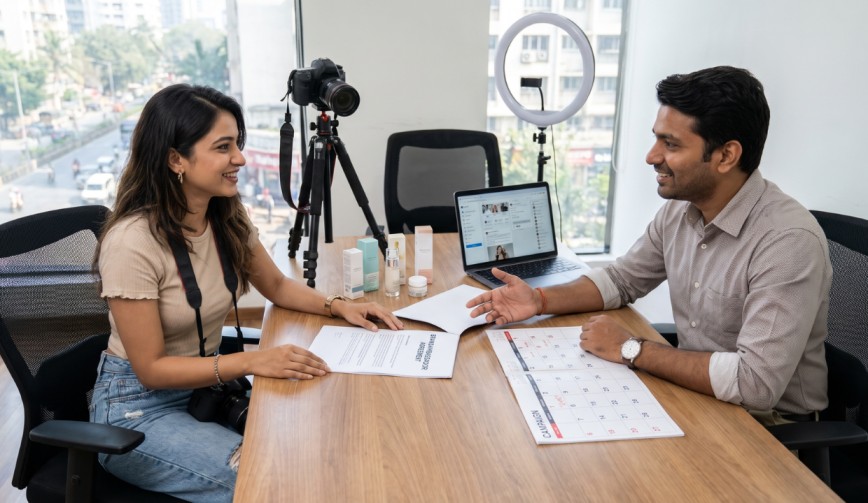
(Source – OpenAI)
It’s a written agreement between a brand and a creator (or celebrity) whereby the creator represents the brand for a defined period of time. It’s not simply a one-off paid post. The creator becomes the face of the brand for a period of time. The contract sets out what both parties have agreed to, so there’s no ambiguity down the line. You’ll also sometimes hear it referred to as a brand ambassador contract or an influencer contract.
👉Click here to see how Boss Wallah works with brands and what we can build for you
How It Works in India
India has no special law for brand ambassador type of deals. They’re governed by the Indian Contract Act 1872, as any other business contract. For a contract to be valid there must be:
- Free consent from both parties.
- A lawful object.
- Consideration (money, goods or both).
A digitally signed agreement is valid.
On top of the contract the creators have to comply with the advertising rules. The CCPA and the Advertising Standards Council of India (ASCI) will both expect full disclosure of any paid partnership and for claims to be truthful.
The CCPA can levy:
- A penalty of up to ₹10 lakh on a manufacturer or endorser for a false or misleading advertisement.
- Up to ₹50 lakh in the case of a repeat offence.
- A ban on an endorser from making endorsements for up to one year, and up to three years in the case of a subsequent contravention.
Both the brand and the creator can be liable.
Read More | Meta AI Influencer Campaigns: How Can Brands Plan Smarter Creator Collaborations?
Key Terms to Understand
- Scope of work: The precise deliverables, i.e. number of reels, posts, stories, events or shoots and the platforms.
- Approval process: Does the brand review your content prior to it going live? How many rounds of editing are you allowed? How quickly do they need to get back to you?
- Territory: Where the brand can use your content (India only or worldwide).
- Intellectual property (IP): Your original creative work (videos, photos, captions, etc.).
- Indemnity: A promise to pay the other side’s losses if you breach the contract or otherwise cause them to suffer any legal loss.
- Force majeure: A clause which excuses delay due to events beyond anyone’s control (e.g. a natural disaster).
- Governing law and jurisdiction: Which law applies and in which city will the courts be sitting in the event of any dispute.
Payment Structure
Payment models vary, and many deals mix them:
- Fixed fee: One sum for the whole contract.
- Monthly retainer: A fixed amount each month (provides a steady income).
- Per deliverable: A fee for each reel, post or event.
- Performance based: A bonus or commission linked to sales via a code or link.
- Barter or product based: Free products or services in lieu of, or in addition to, cash.
Check the due dates, the invoicing process and what happens if payment is late (a late fee or interest is a good indication).
Find out whether the amount is before or after GST as you may be required to charge it if you’re registered. Brands will often take TDS (tax deducted at source) which you can claim when you file your return. Gifts and free products can also be taxable above certain thresholds, so get your chartered accountant’s advice on any significant deals.
Rights and Responsibilities
Creator’s Responsibilities
- Deliver content on time and to the agreed standard.
- Disclose the paid partnership clearly (#ad or the platform’s paid partnership tool).
- Make only honest claims you can support.
- Avoid public conduct that damages the brand, if the contract includes a conduct clause.
- Keep confidential information private.
Creator’s Rights
- Timely payment as agreed.
- Credit and fair treatment in how your content is used.
- Ownership of your content unless you clearly transfer it.
- Reasonable approval timelines.
- A way to exit if the brand breaks the contract.
Brand’s Responsibilities
- Pay on time.
- Share accurate product information and approved claims.
- Give timely feedback.
- Use your content only as allowed.
Exclusivity Clauses
An exclusivity clause prevents you from working with any competing brands during the contract and often for a period after it too. Check three things:
- Category width: “Skincare brands” is narrower than “all beauty and wellness brands”.
- Duration: Does it end with the contract or does it carry on for months afterwards?
- Compensation: Longer or wider exclusivity should be rewarded with a higher fee.
Also ask whether your existing partnerships are permitted to continue and list them in the contract so there’s no argument about that later on.
Contract Duration
The vast majority of ambassador deals are between 3 and 12 months though some are longer.
The contract should have:
- A clear start and end date.
- A defined usage rights period (i.e. how long the brand can continue to use your content after the deal has finished).
A fairly common trap is to have a very short contract with usage rights that extend for years without any additional payment. Always ask for a defined time period.
Read More | Top 10 Influencer Marketing Platforms in India for Brands and Creators.
Renewal
Renewal terms are frequently ignored. Watch for:
- Auto-renew: The contract will renew automatically unless you cancel. Check the notice period and set a reminder.
- Right of first refusal: The brand gets the first opportunity to renew prior to you being able to go to a competitor.
- Fee revision: Whether the fee goes up at renewal, particularly if your following has increased.
A better route is a renewal which requires a fresh written agreement from both parties so that you can then renegotiate.
What to Check Before Signing

(Source – OpenAI)
Before signing a brand ambassador agreement, make sure you check the following:
- Are the deliverables and the numbers specific and measurable?
- Are the total fees, the payment schedule and the tax treatment all clear?
- How broad and how long is the exclusivity?
- What are the usage rights (platforms, territory, duration, paid ads)?
- Who owns the content?
- Can both sides walk away from the contract and if so with how much notice?
- What happens to the outstanding fees if the brand pulls out early?
- Is the indemnity limited to your own acts?
- Are there approval times so that your posts don’t get stuck in the queue?
- What are the renewal terms?
- Does the contract comply with the disclosure rules and who is liable in relation to any claims made about the product?
Need Videos, Creators, or Regional Content for Your Brand?
Boss Wallah helps brands plan and execute video content at scale, without managing multiple vendors.
We work with companies to:
- Shoot large volumes of short-form videos using real creators and studio setups, suitable for social media, websites, campaigns, and launches
- Adapt the same videos for different languages, regions, and platforms, so one shoot works across India and global markets
- Launch products or campaigns through dozens or hundreds of creators, all managed, tracked, and reported in one system
- Support brands with ongoing content, launches, regional expansion, and performance-focused campaigns
Whether you need videos for a new launch, content for multiple markets, creator-led visibility, or a steady content pipeline, Boss Wallah acts as a single partner handling production, creators, and execution end-to-end.
👉Click here to see how Boss Wallah works with brands and what we can build for you
Final Thoughts
A brand ambassador agreement isn’t there to scare you. It’s there to ensure that everyone is on the same page prior to the cameras even starting to roll. Read every clause, ask for changes in writing, keep copies of all your correspondence and all the signed documents and absolutely do not sign under any kind of time pressure. For a big deal, a very brief consultation with a solicitor is absolutely worth the cost.
FAQs
1. Is a brand ambassador agreement legally binding in India?
Yes. If both parties freely agree, the object is lawful and there is a consideration, it is a valid contract under Indian law. A digital signature is also acceptable.
2. How is a brand ambassador any different to a regular sponsored influencer?
A sponsored influencer will typically just do a one-off or a short series of paid posts. A brand ambassador is someone you work with over a longer period of time (often over months), they’re the face of the brand. That’s why the contract is much more detailed.
3. Can I work with other brands during the term of the contract?
Only if the agreement permits it. If there’s an exclusivity clause in place you could be precluded from promoting competing products. Ask for a clear list of what is and what isn’t allowed and have your existing partnerships referenced in writing.
4. Do I have to say that my post is paid?
Yes. Indian rules require creators to clearly disclose paid partnerships. Using labels like #ad or the platform’s paid partnership tool is the safe way. Skipping this can lead to fines and harm your credibility.
5. What should I do if the brand delays payment or breaks the contract?
First, check the payment and termination clauses and send a written reminder. If that does not work, send a legal notice. A contract with fixed due dates, late payment charges and a clear exit clause makes this much easier to handle.