Social Commerce in India Is Changing How Creators and Small Brands Sell Online

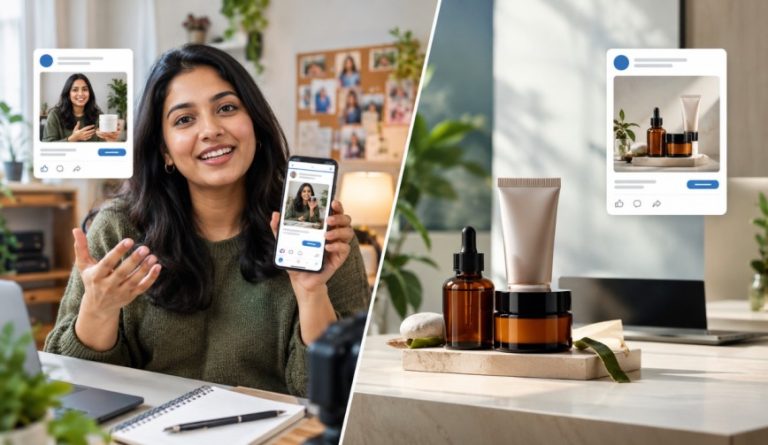
For years, social media was mainly about attracting attention. When a brand put up a photo of a product, it hoped people would like it and then waited for someone to click the link in its bio. Social Commerce in India Is Changing How Creators and Small Brands Sell Online by bringing product discovery, creator recommendations, conversations, and shopping closer together. Recent industry reports also indicate that creators, short-form videos, and messaging are becoming an important part of India’s shopping journey.
What Does Social Commerce Mean in India?
(Source – OpenAI)
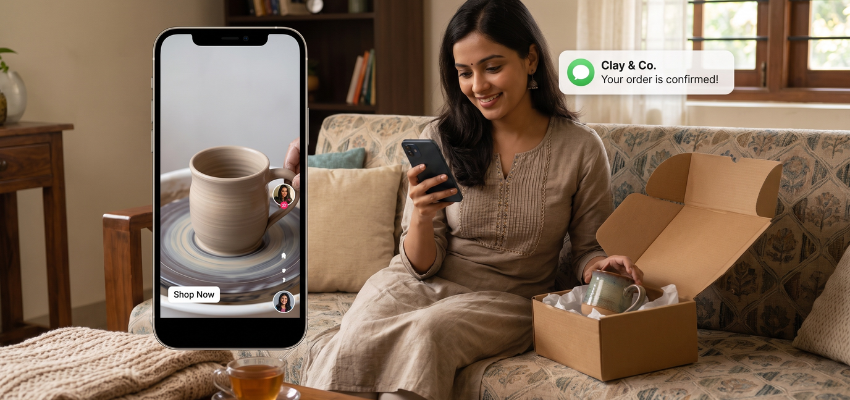
Social commerce in India involves using social media to help people discover, understand, and buy products or services.
People might come across a product not by looking for it, but by seeing a Reel, following a creator, checking a recommendation, or talking to a friend.
The journey can look like this:
Reel → Product discovery → Creator recommendation → Question → Purchase
Shopping becomes a more natural experience because the product appears in a place where people are already spending their time.
👉Click here to see how Boss Wallah works with brands and what we can build for you
Creators Are Becoming Part of the Buying Process
Creators are no longer useful only because they have a large number of followers.
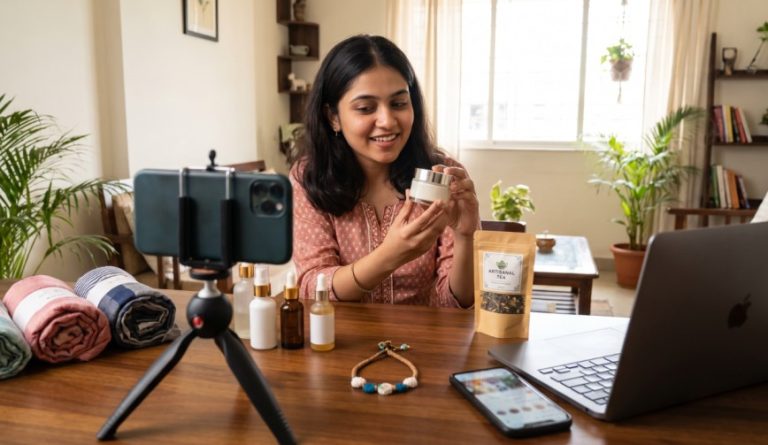
A creator with a highly engaged audience can present a product to people who are genuinely interested in that area. This can be especially useful for small brands that do not have the budget for large advertising campaigns.
For instance, a skincare creator could demonstrate how they use a product over the course of a week rather than simply holding the bottle and saying it is great.
It gives the audience something useful to watch.
It also gives the brand content that feels more natural.
One reason creator-led commerce is expanding in India is that companies such as Flipkart and Myntra launched Meta affiliate partnerships in 2026, enabling creators to include products in their content and earn from resulting sales.
Small Brands Do Not Need to Look Like Big Brands
A small business can actually benefit from the informal side of social media.
For example:
- A handmade jewellery brand can show what an item looks like when worn with an outfit.
- A food brand can show how its product is used at home.
- A local fashion business can collaborate with creators to show its products in everyday situations.
This type of content can make a brand feel more approachable.
That matters because customers often want to see what a product looks like in real life before spending money on it.
This is also where UGC marketing in India becomes useful.
UGC stands for user-generated content. In simple terms, it is content created by customers or creators rather than by the brand itself.
Common examples include:
- Customer reviews
- Unboxing videos
- Product demonstrations
- Everyday product-use videos
- Customer photos
Reels Are Turning Product Discovery Into Entertainment
People do not always open Instagram because they want to shop.
They open it to see something interesting.
That is why short-form video has become so important for social commerce in India.
A product Reel does not need to feel like an advertisement. It could show:
- A common problem and how the product solves it
- A quick product demonstration
- A before-and-after routine
- Three ways to use a product
- A creator’s honest experience
- A comparison between two products
The product becomes part of the content instead of interrupting it.
Research published by Meta in 2026 also showed that short-form video and creators are increasingly influencing product discovery and purchase journeys in India.
Read More | Outsource Social Media: Why People Notice When Your Brand Goes Quiet.
WhatsApp Is Becoming Part of the Shopping Journey
For Indian customers, shopping does not always end when they see a product.
They may have questions first:
- “Is this available?”
- “What size should I choose?”
- “How long will delivery take?”
- “Is this available in another colour?”
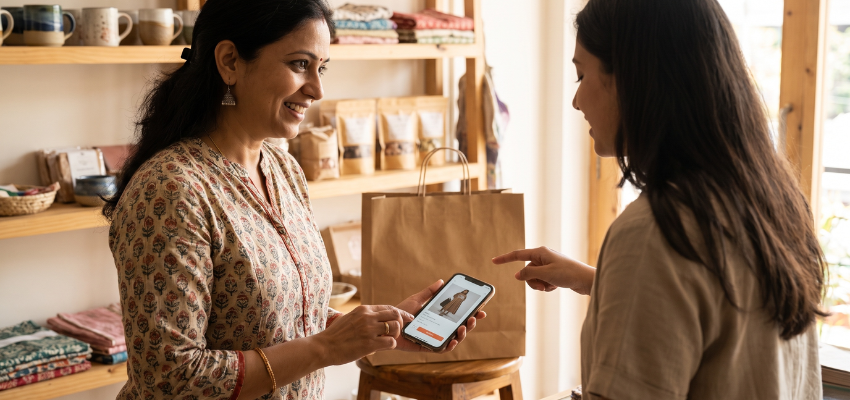
WhatsApp can help businesses handle these conversations.
This is known as conversational commerce, which simply means using messaging conversations to help customers discover products, ask questions, and make purchases.
The benefit is straightforward. Customers can speak directly with the business instead of completing a lengthy contact form and waiting for a response.
Meta’s 2026 research into the Indian retail market also points to WhatsApp’s increasing role in product discovery and customer conversations.
Social Proof Can Make a Product Easier to Trust
Picture yourself coming across two products online.
One has a polished product photo.
The other has several customers showing how they use it.
Which one gives you more information?
That is where social proof becomes important.
Social proof means seeing evidence that other people have used, enjoyed, talked about, or recommended something.
For brands, this can come from:
- Customer reviews
- Creator videos
- Instagram comments
- UGC
- Product demonstrations
- Customer photos
- Creator recommendations
The content does not need to look perfect.
In fact, content that looks too polished can sometimes feel like a traditional advertisement.
Regional Creators Can Help Brands Reach Specific Audiences
India is not one single market.
People in different cities and regions can have different languages, habits, interests, and shopping preferences.
This gives brands an opportunity to work with influencers in India and regional creators who already understand their audience.
When a creator speaks naturally in a regional language, the product can feel more familiar.
For a brand, this can be more useful than simply trying to reach the largest possible audience.
It is less about shouting at everyone and more about speaking clearly to the right people.
Small Brands Should Not Chase Every Trend
There is a tendency to jump on every trending audio, meme, and content format.
But just because a Reel is trending does not mean it will lead to sales.
A more useful approach is to create content around questions customers already have.
For example:
- Customer question: Is this product easy to use?
Content idea: Show how to use it in 20 seconds. - Customer question: Which product should I choose?
Content idea: Create a simple comparison video. - Customer question: Does it really look like the pictures?
Content idea: Show the product in normal lighting.
Content like this can continue to be useful even after a trend disappears.
Social Commerce Is Changing Brand-Creator Partnerships
The old model was often simple:
Brand pays creator → Creator posts → Campaign ends
Brands can now build longer relationships with creators.
A creator can help with:
- Product launches
- UGC
- Reviews
- Affiliate sales
- Customer questions
- Ongoing content
This means creators can become more than promotional partners.
They can become part of a brand’s sales and content system.
This can be particularly useful for small businesses because one creator relationship can result in several types of content instead of just one sponsored post.
Read More | Why Every Growing Business Needs a Strong Social Media Strategy Before Expanding.
What This Means for Small Indian Brands
(Source – OpenAI)
The opportunity is not just about selling directly through social media.
It is about making the whole buying process simpler.
A customer should be able to:
Discover the product → Understand it → Trust it → Ask questions → Buy it
Creators, Reels, UGC, Instagram, YouTube, and WhatsApp can each support different parts of this journey.
Brands that understand this do not need to turn every post into a sales pitch.
Sometimes, simply showing the product, answering a common question, or having a creator demonstrate it can have a greater effect.
Social commerce is making shopping feel less like a separate activity and more like something that happens naturally while people browse, watch, and talk online.
Need Videos, Creators, or Regional Content for Your Brand?
Boss Wallah helps brands plan and execute video content at scale, without managing multiple vendors.
We work with companies to:
- Shoot large volumes of short-form videos using real creators and studio setups, suitable for social media, websites, campaigns, and launches
- Adapt the same videos for different languages, regions, and platforms, so one shoot works across India and global markets
- Launch products or campaigns through dozens or hundreds of creators, all managed, tracked, and reported in one system
- Support brands with ongoing content, launches, regional expansion, and performance-focused campaigns
Whether you need videos for a new launch, content for multiple markets, creator-led visibility, or a steady content pipeline, Boss Wallah acts as a single partner handling production, creators, and execution end-to-end.
👉Click here to see how Boss Wallah works with brands and what we can build for you
Final Thoughts
Social commerce in India is changing the way creators and small brands sell online by reducing the gap between discovering a product and purchasing it.
For brands, the opportunity is not about being everywhere or posting every day. It is about creating useful content, working with creators who understand the right audience, and making it easy for people to ask questions and take the next step.
Companies that focus on real conversations, relatable content, and simple buying experiences can build stronger connections with customers. Social media is no longer just a place to display products. It is becoming part of how people decide what is worth buying.
FAQs
1. What is social commerce in India?
Social commerce in India means using social media to help people discover, consider, and buy products or services.
2. What role do creators play in social commerce?
Creators can introduce products through reviews, demonstrations, recommendations, UGC, and affiliate content.
3. What is UGC marketing?
UGC marketing uses content created by customers or creators to show how a product looks, works, or fits into everyday life.
4. Is WhatsApp useful for social commerce?
Yes. Businesses can use WhatsApp to answer questions, share product information, communicate with customers, and support purchases.
5. Do small brands need a large following for social commerce?
No. A smaller audience can still be valuable when the people following the brand are genuinely interested in its products.