AI Search vs Google Search: What Businesses Must Do to Stay Visible
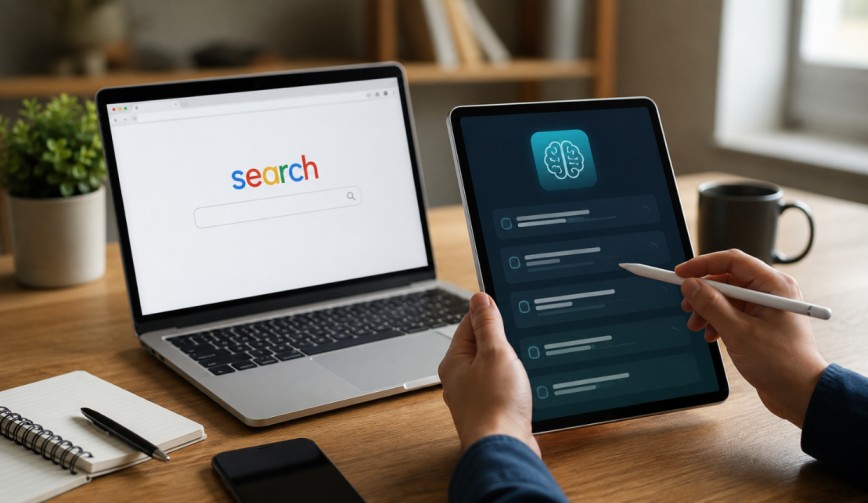
For years, being found online meant one thing: ranking on Google. Businesses focused on keywords, links, and getting onto that first page of results. But something is changing fast. People now ask ChatGPT, Perplexity, and Google’s own AI summaries for answers instead of typing a query and scrolling through ten blue links.
This is the heart of the AI Search vs Google Search conversation, and it’s something every business owner should understand today, not next year.
Let’s look at what’s really changing, why it matters, and what you can do about it, in simple words anyone can follow, even if you’re not a tech person at all.
What Is the Real Difference Between AI Search and Google Search?
(Source – OpenAI)
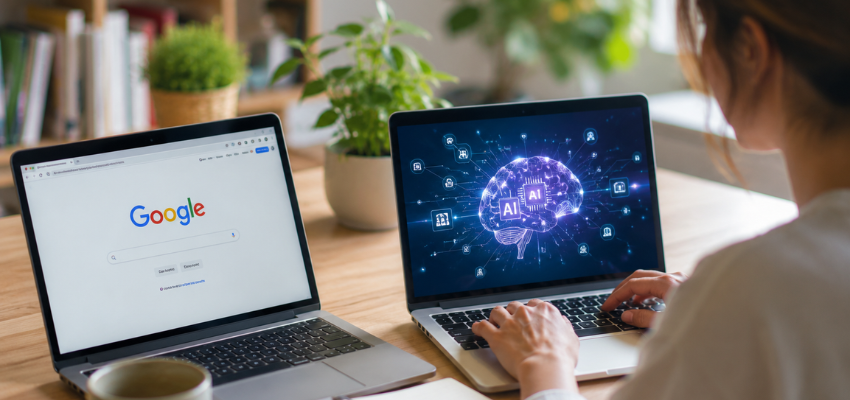
Think of Google Search as a librarian. You ask a question, and the librarian hands you a pile of books and says, “Here, find your answer in these.” You still have to read and choose.
AI Search is more like a smart friend who has already read all the books and just tells you the answer straight away. Tools like ChatGPT and Google AI Overviews read many websites, understand them, and give you one clear answer in normal, conversational language.
| Feature | Google Search | AI Search |
|---|---|---|
| What you get | A list of website links | One direct answer |
| Effort needed | You click and read | You just read the answer |
| Best for | Local searches, shopping, deep research | Quick questions, general information |
| Website traffic | Sends visitors to your site | May answer without sending any visitors |
That last row is exactly why business owners are worried.
👉Click here to see how Boss Wallah works with brands and what we can build for you
Why This Shift Matters for Businesses
Here’s the tricky part. If an AI tool answers a question directly using your website’s content, your business gets no click, no visit, and no credit shown to the user. This is called a zero-click search, meaning people get their answer without ever opening your website.
So even if your content was the actual source, you might not get the traffic or the sale. This is a real concern for businesses that have spent years on SEO, or Search Engine Optimisation, which simply means improving your website so it ranks higher on search engines.
But don’t worry. Being invisible to AI search is not something you have to accept. It just means the rules have changed a bit, and businesses need to adjust instead of hoping everything stays the same forever.
Read More | AI vs Human Creativity: What Still Matters in Content Creation?
How Does AI Search Choose What to Show?
AI tools don’t just make up answers randomly. They pull real information from websites and decide which ones seem trustworthy enough to use. Here is what usually helps:
- Clear and simple content: AI tools prefer information that is easy to understand, with direct answers and no unnecessary filler.
- Authority and trust: If your website has good reviews, mentions from other sites, and useful backlinks, AI is more likely to use it as a source.
- Fresh information: Old or outdated content often gets skipped in favour of recent and accurate updates.
- Structured data: This is a small piece of code, also called schema markup, added to your website. It works like a label that tells search engines exactly what your content is, such as a price, a review, or a recipe, instead of making them guess.
This growing focus has given rise to a new term called Answer Engine Optimisation (AEO). Think of it as the younger sibling of SEO. Instead of just trying to rank on a page, AEO tries to get your content picked as the actual answer.
Is Google Search Going Away?
Not at all, so no need to panic. Millions of people still use Google every single day, especially for local SEO searches like “plumber near me” or “best bakery in town.”
What’s really happening is that search is splitting into two paths:
- Quick, general questions are increasingly answered by AI tools.
- Local searches, shopping, and detailed research still rely heavily on traditional Google results.
So the smart move isn’t picking one over the other. It’s showing up well in both places at the same time.
What Businesses Must Do to Stay Visible

(Source – magnific.com)
Here comes the practical part. These small changes can make a big difference over time.
- Write for people first, not machines. Avoid stuffing your content with keywords. Write like you’re explaining something to a friend, because AI tools can easily spot content that sounds robotic.
- Use clear structure. Short paragraphs, simple headings, and bullet points make it easy for both readers and AI tools to understand your page quickly.
- Answer questions directly. If someone asks “what is the best time to post on Instagram,” give the answer first, then explain why.
- Add structured data. Ask your website developer to add schema markup so search engines and AI tools clearly understand your prices, products, and services.
- Build real trust. Collect genuine customer reviews, get mentioned on other reputable websites, and keep your information accurate.
- Don’t ignore local search. Keep your Google Business Profile updated, since local SEO still plays a big role in both Google Search and AI Search.
- Keep content fresh. Regularly updating your blog posts, FAQs, and product pages shows both Google and AI tools that your business is active and reliable.
Businesses should also keep an eye on generative search trends and even voice search, since more people are speaking their questions to smart assistants instead of typing them.
Read More | From Content Creation to Content Generation: The AI Infrastructure Shift.
A Simple Way to Understand This
Imagine your business is a small shop in a busy market. Google Search is like a signboard pointing shoppers toward your shop. AI Search is like a helpful shopkeeper down the street who tells customers exactly what they need, sometimes recommending your shop, sometimes not.
Your goal now is to make sure both the signboard and the shopkeeper know your shop well enough to recommend it with confidence.
Need Videos, Creators, or Regional Content for Your Brand?
Boss Wallah helps brands plan and execute video content at scale, without managing multiple vendors.
We work with companies to:
- Shoot large volumes of short-form videos using real creators and studio setups, suitable for social media, websites, campaigns, and launches
- Adapt the same videos for different languages, regions, and platforms, so one shoot works across India and global markets
- Launch products or campaigns through dozens or hundreds of creators, all managed, tracked, and reported in one system
- Support brands with ongoing content, launches, regional expansion, and performance-focused campaigns
Whether you need videos for a new launch, content for multiple markets, creator-led visibility, or a steady content pipeline, Boss Wallah acts as a single partner handling production, creators, and execution end-to-end.
👉Click here to see how Boss Wallah works with brands and what we can build for you
Final Thoughts
The AI Search vs Google Search debate isn’t really about picking a winner. It’s about understanding that being visible today means showing up in more places and in more useful ways, whether that’s a human scrolling through Google or an AI tool reading on their behalf.
Businesses that focus on clear writing, honest information, and strong search visibility across both platforms will be the ones still standing out in the years ahead. Those who ignore this shift might quietly disappear from both the signboard and the shopkeeper’s recommendations.
Have an idea but don’t know the first step?
BossWorks builds a step-by-step business plan tailored to your city and business type, with real costs, funding options, and launch tasks all in one place. Built for first-time founders, from idea to open.
Frequently Asked Questions
1. What is the main difference between AI Search and Google Search?
Google gives you a list of links to click, while AI Search gives you one direct, ready-made answer.
2. Will AI Search completely replace Google Search?
Not likely soon, since Google still leads in local searches, shopping, and detailed research.
3. What is Answer Engine Optimisation (AEO)?
It means shaping your content so AI tools are more likely to pick it as the direct answer.
4. Do small businesses really need to worry about AI Search?
Yes, because clear and trustworthy content helps visibility on both Google and AI search tools.
5. How can I check if AI tools are mentioning my business?
Simply ask relevant questions on tools like ChatGPT or Perplexity and see if your business shows up.