Why Facebook Ads Fail for E-Commerce: What Happens After the Click Matters More Than You Think
Running Facebook ads for an e-commerce store often feels exciting in the beginning. You create an ad, choose your audience, set a budget, and wait for sales to start rolling in. At first, everything seems promising because clicks start coming in. Traffic increases, website visits go up, and you feel like your campaign is doing well.
Then reality arrives like an unexpected bill.
You notice that despite getting plenty of clicks, sales are either very low or completely missing. This is the moment when most business owners start asking the same question: why Facebook ads fail for e-commerce businesses even when the ads seem to be working?
The answer is usually simple. The problem is not always the ad itself. The real issue often begins after the click.
The Biggest Mistake: Treating Clicks Like Sales

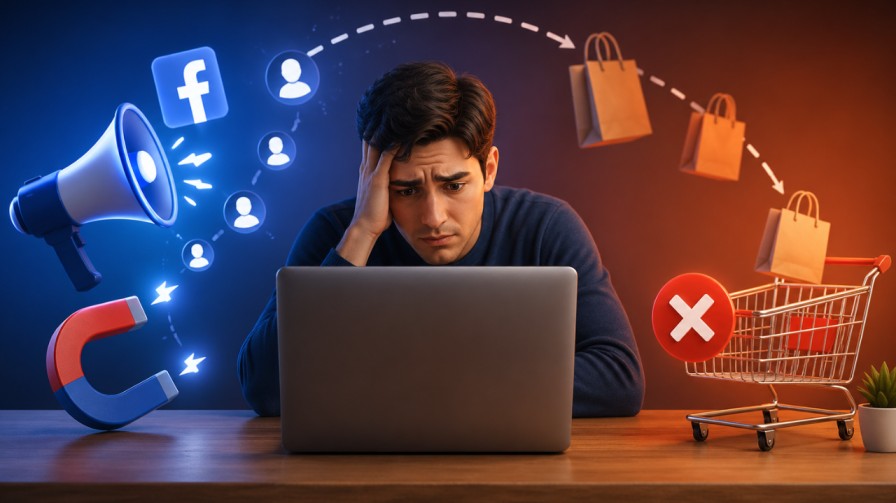
(Source – freepik.com)
Many e-commerce businesses celebrate clicks as if they are sales. While clicks are important, they are only the beginning of the customer journey.
A click simply means someone was interested enough to tap on your ad. It does not mean they are ready to buy.
Think of it this way. If your ad is an invitation to a party, your website is the actual party. You can send the fanciest invitation in town, but if guests arrive to find bad music, no snacks, and awkward silence, they will leave quickly.
The same logic applies to your online store.
A user clicks because your ad grabbed attention. What happens next decides whether they stay or leave.
👉Click here to see how Boss Wallah works with brands and what we can build for you
What Happens After the Click Actually Matters More
The moment a visitor lands on your website, they start making quick judgments.
Within a few seconds, they are silently asking questions such as:
- Does this page match what I expected?
- Can I trust this website?
- Is this product worth buying?
- Is it easy to place an order?
If the answer to any of these questions is unclear, visitors often leave without buying anything.
This is one of the biggest e-commerce conversion problems businesses face.
Conversion simply means turning a visitor into a customer. Getting traffic is easy compared to earning trust and driving action.
Common Reasons Why Facebook Ads Fail for E-Commerce
There are several common reasons why visitors click but do not buy. Let’s understand the most important ones.
1. Slow Website Speed
Website speed has a bigger impact than many people realise.
When your page loads slowly, visitors lose patience. Online shoppers are not famous for waiting around like they are in a peaceful meditation class.
A slow-loading website can:
- Increase bounce rate
- Reduce user engagement
- Lower conversion rates
Bounce rate means visitors leave your website without taking any action.
If your page takes too long to load, users may leave before even seeing your product.
ALSO READ | Short Video Ads Production Company in India: Make Every Second Count in Advertising.
2. Weak Product Pages
A product page is not just a place to display a product. It is a sales page.
Many businesses make the mistake of keeping product pages too basic. They show one or two images, a price, and a short description, then wonder why customers disappear.
A strong product page should include:
- Clear product images
- Easy-to-read descriptions
- Product benefits
- Pricing details
- Customer reviews
Customers want clarity before they spend money.
If your page creates confusion, your ads are basically paying to bring visitors to a dead end.
3. Poor Mobile Experience
Most Facebook users browse on mobile devices. This means your website needs to work smoothly on phones.
Unfortunately, many stores still offer a frustrating mobile experience.
Common mobile problems include:
- Small buttons
- Text that is hard to read
- Slow loading pages
- Images not fitting properly
Mobile optimisation means making your website easy to use on smartphones and tablets.
Without this, your potential customers may leave before reaching checkout.
4. Lack of Trust Signals
People are careful while shopping online, especially from stores they have never visited before.
If your website does not look trustworthy, customers hesitate.
Important trust signals include:
- Customer testimonials
- Secure payment icons
- Return policy information
- Contact details
These small elements make customers feel safer.
Without trust, even interested users may decide not to buy.
5. Complicated Checkout Process
Sometimes businesses do everything right until the final step.
A customer adds products to the cart but leaves during checkout.
Why?
Because the checkout process feels like an exam nobody prepared for.
Common checkout mistakes:
- Too many form fields
- Forced account creation
- Hidden shipping charges
- Limited payment methods
A good checkout process should be:
- Fast
- Simple
- Transparent
Checkout optimisation means making the payment process easy enough that users do not abandon their cart halfway through.
6. Ad and Landing Page Mismatch
Your ad and landing page should feel connected.
For example, if your ad promises a discount, the landing page should clearly show that same offer.
When there is a mismatch, users feel confused or misled.
This can lead to:
- Lower trust
- Higher bounce rate
- Poor Facebook ads conversion rate
Consistency is essential.
7. No Clear Call to Action
A visitor should never have to guess what to do next.
That is why every page needs a clear call to action.
Examples include:
- Buy Now
- Add to Cart
- Shop Today
A call to action is simply an instruction telling the visitor what step to take next.
Without it, users may browse and leave without making a decision.
ALSO READ | Short Video Ads Production Company in India: Why 15 Seconds Can Outperform 15 Pages.
Focus on the Full Funnel, Not Just Ads

(Source – freepik.com)
Many businesses keep changing their ads repeatedly.
They test:
- New audiences
- New creatives
- New budgets
While testing ads is useful, it is not enough.
A sales funnel is the full journey from seeing your ad to completing a purchase.
To improve your results, focus on the entire funnel:
- Better landing pages
- Faster website speed
- Clear product pages
- Easy checkout
This is how you improve e-commerce sales without constantly blaming the ads.
Need Videos, Creators, or Regional Content for Your Brand?
Boss Wallah helps brands plan and execute video content at scale, without managing multiple vendors.
We work with companies to:
- Shoot large volumes of short-form videos using real creators and studio setups, suitable for social media, websites, campaigns, and launches
- Adapt the same videos for different languages, regions, and platforms, so one shoot works across India and global markets
- Launch products or campaigns through dozens or hundreds of creators, all managed, tracked, and reported in one system
- Support brands with ongoing content, launches, regional expansion, and performance-focused campaigns
Whether you need videos for a new launch, content for multiple markets, creator-led visibility, or a steady content pipeline, Boss Wallah acts as a single partner handling production, creators, and execution end-to-end.
👉Click here to see how Boss Wallah works with brands and what we can build for you
Final Thoughts
Why Facebook ads fail for e-commerce is not always because of poor ad targeting or weak creatives.
In many cases, the ads are doing their job perfectly.
The real issue begins after the click.
If your website is confusing, slow, or difficult to trust, visitors leave. But when your website experience is smooth, clear, and customer-friendly, your chances of conversion improve dramatically.
So before you blame Facebook, take a closer look at your website.
Sometimes the ad is not the problem. It is just bringing attention to one.
FAQs
1. Why Facebook ads fail for e-commerce even with high traffic?
Because traffic alone does not create sales. A poor website experience often prevents conversions.
2. How can I improve the Facebook ads conversion rate?
Focus on landing page quality, website speed, and checkout simplicity.
3. Why is mobile optimisation important for e-commerce ads?
Most Facebook traffic comes from mobile users, so a poor mobile experience can reduce conversions.
4. What are trust signals in e-commerce?
Trust signals include reviews, secure payment icons, return policies, and clear contact details.
5. Should I stop ads if sales are low?
Not immediately. First, review what happens after the click and improve your conversion funnel.