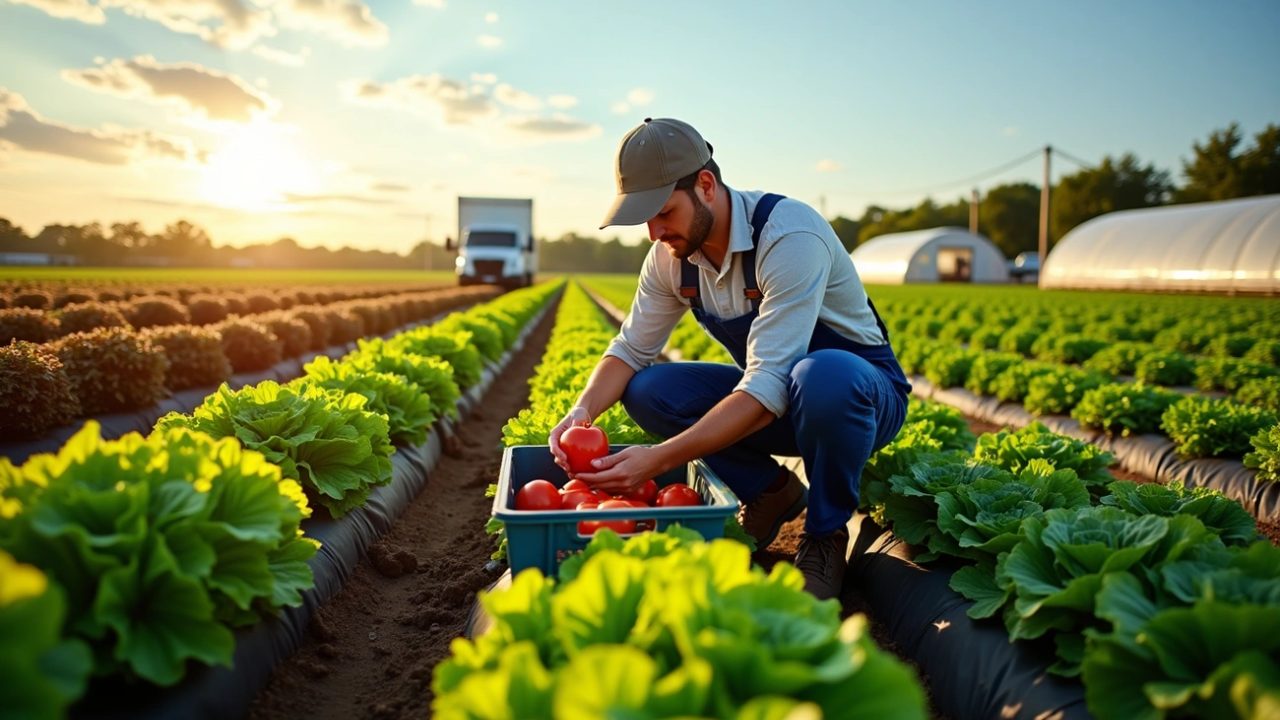
- High-Profit Potential: Vegetable farming can deliver 20–35% profit margins, often outperforming traditional crops.
- Strategic Crop Selection: Choosing vegetables suited to your region’s soil, climate, and market demand is key to success.
- Efficient Resource Management: Proper land preparation, irrigation planning, and pest control optimize yields and reduce costs.
- Flexible Marketing Options: Farmers can sell via wholesale, retail, contract farming, or direct-to-consumer channels for varying returns.
- Low Entry Barrier: Startup costs average around ₹18–20 lakh (€19,815), making it viable for small-scale entrepreneurs
- Community Impact: Beyond profits, it boosts food security, promotes healthy eating, and supports eco-friendly agriculture.
Vegetable farming business plans guide farmers toward higher profits, with the global vegetable market projected to reach ₹1,96,83,510 crore by 2028 at a 5.4% CAGR. Even small-scale farms can earn 20–35% profit margins with an average startup cost of about ₹17 lakh. This guide shares profitable ideas and key factors for success.
Understanding the Basics of Vegetable Farming

The vegetable farming sector keeps growing and brings both economic and nutritional benefits to farmers and consumers. India stands as the second-largest producer of vegetables worldwide and contributes 13.38% of total vegetable production. Anyone who wants to start this profitable venture needs to understand the basics.
Why vegetable farming is a growing business
Vegetable farming is a chance to make good money for several reasons. Vegetables bring higher profit margins than traditional field crops. The vegetable market stays stable and profitable while conventional crops face price swings. Many vegetables have shorter growth cycles that allow multiple harvests annually and create steady income streams. Vegetables need less land than conventional crops, which makes them perfect for farmers with small plots. On top of that, it creates millions of jobs in cultivation, transportation, packaging, and marketing because of its labour-intensive nature.
Types of vegetables and their market demand
Market demand varies substantially based on vegetable types:
High-Profit Vegetables:
- Tomatoes – These rank among the most profitable because of high demand and use in both fresh consumption and processed products
- Sweet peppers – People love them for their vibrant colours and nutritional value
- Leafy greens – Quick turnaround times make them valuable in the market
- Carrots – These prove profitable due to their long shelf life and health benefits
- Cucumbers – Farmers value them for high yields and multiple harvests per season
Farmers must plan seasons carefully. Vegetables fall into two groups: cool-season annuals (broccoli, cabbage, carrots) and warm-season annuals (beans, cucumbers, tomatoes). This helps farmers create year-round production cycles.
Urban vs rural vegetable farming opportunities
Urban farming shows surprising results compared to conventional agriculture. City plots produce up to four times more food than conventional farms per square meter. Controlled growing conditions, vertical production methods, and better space efficiency make this possible. Urban areas provide chances through container gardening, hydroponic systems, and rooftop cultivation that use limited space wisely.
Rural settings shine with more land availability, lower costs, and strong agricultural communities. Both environments offer unique advantages that farmers can tap into for a successful business plan.
| Factor | Urban Farming | Rural Farming |
|---|---|---|
| Space Efficiency | Higher (vertical options) | Lower (traditional methods) |
| Production per m² | Up to 4x conventional farming | Standard yields |
| Market Access | Direct to consumers | Often requires distribution |
| Initial Costs | Higher startup investments | Lower land costs |
| Growing Methods | Often hydroponics/containers | Traditional soil-based |
| Water Usage | Often more efficient | Typically higher consumption |
Creating a Vegetable Farming Business Plan
Your vegetable farming venture needs a well-laid-out business plan as its foundation. This roadmap will guide your decisions and help you secure financing whenever needed.
1. Define your business goals and model
Start with clear objectives for your vegetable farm. To name just one example, Silver Mountain Farmland wants to “increase crop production by 25% in 5 years and gain INR 67504360.64 in annual revenue for 3 years”. Make your goals specific, measurable, and time-bound.
Your business model should align with one of these approaches:
- Direct-to-consumer: Better margins through farmers’ markets or CSA programs
- Wholesale: Regular income from established buyers
- Value-added: Processed vegetables that bring higher profits
A unique selling proposition makes you stand out—maybe even with “high quality, organic, and pesticide-free” produce.
2. Choose the right crops for your region
Let’s take a closer look at the factors that influence crop selection:
- Market demand: Popular vegetables like tomatoes, onions, and potatoes stay in demand
- Climate suitability: Your region’s growing conditions should match your crops
- Soil compatibility: A full soil test reveals pH levels (best between 6.0 and 7.5)
- Profit potential: Research shows vegetable farming’s profit margins reach 20-35%
Crop rotation and diversification help you “reduce risks and improve soil fertility”.
3. Estimate land, labour, and equipment needs
Your resource requirements need careful calculation:
- Land: Agricultural value runs about INR 55775.48 per acre
- Labour: Rates vary from operator (INR 1221.83/hour), regular hired (INR 854.77/hour), to seasonal (INR 610.91/hour)
- Equipment: You’ll need a reliable tractor (40-50 horsepower), tillage implements, irrigation systems, and harvest containers
A one-acre mixed vegetable farm’s original investment typically covers land preparation (INR 10,000), seeds (INR 8,000), fertilisers (INR 12,000), and irrigation setup (INR 20,000).
4. Plan your planting and harvesting schedule
Your complete planting calendar should account for different vegetable types:
- Cool-weather crops (broccoli, lettuce, spinach): Early spring and fall planting
- Warm-weather crops (tomatoes, peppers, eggplant): Plant after frost risks pass
Success comes from “sowing seeds or transplanting seedlings at regular intervals” for ongoing harvests.
5. Sample vegetable farming business plan structure
Your complete plan should cover:
- Executive summary: Your farm’s overview and objectives
- Products and pricing: Crop choices with price ranges
- Market analysis: Customer targets and competition study
- Operations plan: How you’ll produce and manage resources
- SWOT analysis: Your strengths, weaknesses, opportunities, and threats
- Financial projections: Your budget and revenue forecasts
| Resource Category | Estimated Cost (INR) | Considerations |
|---|---|---|
| Labour (3 months) | 10,000 | Levelling, ploughing, composting |
| Seeds/Seedlings | 8,000 | Variety selection crucial |
| Fertilizers | 12,000 | Organic or conventional options |
| Irrigation setup | 20,000 | Drip systems most efficient |
| Labor (3 months) | 15,000 | Harvesting most labor-intensive |
| Packaging/Transport | 5,000 | Critical for market presentation |
| Miscellaneous | 5,000 | Unexpected expenses buffer |

Managing Production and Operations

Image Source: Agroye
The success of your vegetable production depends on how well you manage your cultivation practices. You need to master these operations to get the best yields and quality produce.
Soil preparation and irrigation setup
Good soil preparation is the lifeblood of successful vegetable farming. Your first task is to make sure water drains well, since soggy soil will hurt early vegetable growth. Plough six to eight inches deep to mix in organic matter, kill weeds, and let the soil breathe better. You can’t skip erosion control—pick terracing, contouring, or strip cropping based on your land’s shape.
Your irrigation choices come down to surface methods (if you have flat land) or sprinkler systems. Drip irrigation saves a lot of water—about half of what sprinklers use and works better too. Think over things like your soil’s texture, how well it holds water, and how close together your plants are before deciding on irrigation.
Seed selection and propagation methods
Start with quality seeds from trusted sources. The best time to sow depends on your local outdoor planting season, usually 4-12 weeks before moving plants outside.
Put moistened growing medium in containers, leaving 3/4 inch at the top. Medium and large seeds need furrows 1/8 to 1/4 inch deep, while very tiny seeds should just be pressed into the medium. A clear plastic or glass cover will keep moisture steady during germination.
Seeds need three things to sprout: they must be viable, have the right internal conditions, and the right environment (moisture, temperature, oxygen). You might want to try pregermination—sprouting seeds before planting cuts down waiting time.
Pest and disease control strategies
The best approach combines several control strategies through Integrated Pest Management (IPM). Keep the areas around your growing spaces clean and weed-free. You should check for pests often using traps and visual checks.
Natural pest control works best—let ladybird beetles handle your aphid problems. Chemical treatments should be your last resort, and you must use products made specifically for your crops.
Bacterial spot, early blight, and powdery mildew are common vegetable enemies. Crop rotation is the quickest way to break disease cycles. Your best defence against common pathogens is to pick disease-resistant varieties.
Harvesting and post-harvest handling
Pick your vegetables at peak ripeness based on what the market wants and what you’re growing. The cool parts of the day are best for harvesting to keep heat damage low. Handle your produce with care to avoid bruises, splits, and skin damage that makes them lose water faster.
After harvest, you’ll need to clean, sort, and grade everything. Washing gets rid of dirt and cuts down on harmful organisms. Take out anything damaged or diseased, then sort by size, colour, and quality.
Different vegetables need different storage—potatoes do well at 15.5-21.1°C in dry spots, while others need to stay cold. The right temperature and humidity levels must stay constant throughout storage and shipping.
Using greenhouses and hydroponics for year-round farming
Greenhouses and hydroponics work together to create perfect growing conditions that don’t depend on outside weather. Hydroponics grows plants in nutrient-rich water solutions instead of soil, which lets you control exactly what your plants get.
This setup offers big advantages: you’ll save 90% water through closed-loop systems, grow more food in less space with vertical farming, deal with fewer pests and use less pesticide, and grow food all year, whatever the weather.
Setting up a hydroponic greenhouse starts with a really good cleaning. You’ll need to put in all the right equipment—nutrient systems, water tanks, and proper lights. Good airflow is crucial, so install fans and vents to control temperature and humidity. Test everything before you add any plants.
| Irrigation Method | Water Efficiency | Initial Cost | Maintenance Needs | Best For |
|---|---|---|---|---|
| Surface (Furrow) | Low | Low | Medium | Level fields, row crops |
| Sprinkler | Medium | Medium | High | Various terrains, most crops |
| Drip | Very High (90% savings) | High | Low | Water-sensitive areas, most vegetables |
Marketing and Profitability Strategies

Image Source: SlideTeam
Marketing makes a vital difference between a profitable vegetable farm and one that barely survives. The right approach to selling your produce can substantially increase your bottom line.
Identifying your target market
You need to know your customers for marketing to work. Start by grouping potential buyers based on demographics, geographics, psychographics, and behaviours. Vegetable farms typically target health-conscious families, local restaurants looking for fresh ingredients, and grocery stores that needa consistent supply.
Your ideal customers can be found by:
- Looking at who buys your produce now and their reasons
- Learning their buying habits and values
- Finding out if they care more about organic certification, local sourcing, or price
Small farm store shoppers usually value local business support, fresh foods, and learning about their purchases.
Direct-to-consumer vs wholesale selling
Each sales channel brings unique benefits. Direct-to-consumer (DTC) sales give you better control, higher margins, and instant customer feedback. You build personal connections with buyers through farmers’ markets, CSA programs, or online stores.
Wholesale offers a broader reach through bulk sales to restaurants, grocery stores, or distributors. The margins might be lower, but wholesale brings bigger orders and steadier revenue. Recent studies show B2B ecommerce reached INR 75815.84 billion in December 2024.
Finding the right balance:
- Try a mixed approach with both wholesale and direct sales
- Offer different products in different channels
- Test new products on your DTC site before showing them to retailers
Branding and packaging your produce
Packaging does several vital jobs: it keeps products fresh, tells your brand’s story, and shapes buying decisions. Green packaging matters more than ever—use biodegradable or recyclable materials to attract environmentally aware buyers.
Your brand can stand out by:
- Understanding your audience through research
- Creating unique colours, logos, and messages
- Trying new ideas like see-through packaging that shows freshness
- Using simple designs that highlight natural beauty
Buyers who care about sustainability prefer cardboard with custom graphics over plastic or wood packaging.
Pricing strategies for maximum vegetable business profit
Create a pricing plan that keeps you profitable yet competitive. These strategies work well:
Cost-plus pricing: Add up all production costs and include a profit margin. If tomatoes cost INR 210.95 per pound to grow, a 30% margin sets the price at INR 274.24.
Market-based pricing: Check what competitors charge. When nearby farms sell zucchini for INR 126.57 per pound, price yours between INR 118.13 and INR 135.01 to stay competitive.
Value-based pricing: Price based on perceived worth, especially for premium items like organic or heirloom varieties.
Dynamic pricing: Change prices based on demand, seasons, or extra stock. This helps sell more and reduce waste during peak harvest.
Government subsidies and support programs
Indian government programs can help cut costs and boost profits through subsidies for:
- Fertilisers and seeds that lower production costs
- Natural farming methods (up to Rs. 20,000 per farmer)
- Modern equipment that streamlines processes
Paramparagat Krishi Vikas Yojana (PKVY) helps pay for organic certification, training, and supplies. These programs cut expenses and improve market access.
Getting these benefits requires registration with your State Agriculture Department, proper documents (Aadhaar, bank details, land records), and attendance at awareness programs.
| Marketing Channel | Profit Margin | Advantages | Challenges |
|---|---|---|---|
| Farmers’ Markets | 30-50% | Direct customer feedback, higher prices | Time-intensive, weather dependent |
| CSA Programs | 25-40% | Upfront cash flow, guaranteed sales | Requires consistent quality and variety |
| Wholesale | 10-20% | Larger volume, steady demand | Lower margins, strict requirements |
| Online Direct | 20-35% | Broader reach, convenience | Shipping logistics, packaging costs |
Key Takeaways

This comprehensive guide reveals how vegetable farming can transform from a simple agricultural venture into a highly profitable business with proper planning and execution.
• Market opportunity is massive: Global vegetable market reaches €1.08 trillion in 2024 with 6.89% annual growth, offering profit margins of 20-35% for farmers.
• Start small with strategic planning: Initial investment of around €19,815 can yield profitable returns within the first growing season on just one acre.
• Choose high-demand crops wisely: Focus on profitable vegetables like tomatoes, peppers, and leafy greens that offer multiple harvests and stable market demand.
• Optimise production with modern techniques: Drip irrigation saves 90% water while hydroponics and greenhouses enable year-round farming with higher yields per square meter.
• Marketing strategy determines profitability: Direct-to-consumer sales offer 30-50% margins versus 10-20% wholesale, but hybrid approaches often work best for sustainable growth.
The key to success lies in balancing production efficiency with smart marketing while leveraging government subsidies and support programs to reduce costs. Whether you’re starting urban container farming or rural field cultivation, this systematic approach provides the foundation for building a thriving vegetable farming business that serves both profit goals and community needs.
Conclusion
Vegetable farming is one of the most profitable and accessible agricultural ventures, offering opportunities from small-scale startups to large operations. Success depends on strategic crop selection suited to soil and market needs, efficient resource use, effective cultivation and pest control, and smart marketing that builds a recognisable brand. With startup costs averaging around €19,815 and profit margins of 20–35%, it can outperform many traditional crops, especially when supported by government subsidies. Beyond income, vegetable farming contributes to local food security, healthier diets, and sustainable agriculture, making it both a wise business decision and a meaningful service to the community.
Explore more blogs to boost your farming knowledge and make smarter agri-business moves.
FAQs
On average, ₹30,000–₹50,000 depending on crop type and irrigation method.
Chilli, tomato, and capsicum offer high returns per acre.
Most vegetables are ready in 60–120 days.
Yes, but yields may be lower initially; prices are higher in the market.
₹80,000–₹1,80,000 depending on crop and market conditions.
Farmers’ markets, farm-to-home delivery apps, and social media.
Not mandatory, but highly recommended to save water and increase yield.
Generally, you need to know about local markets, but check with local authorities for large-scale sales.
Depends on crop — winter is best for leafy greens and cabbage, summer for okra and cucumber.
Yes, but ensure a long-term lease for better returns on investment.