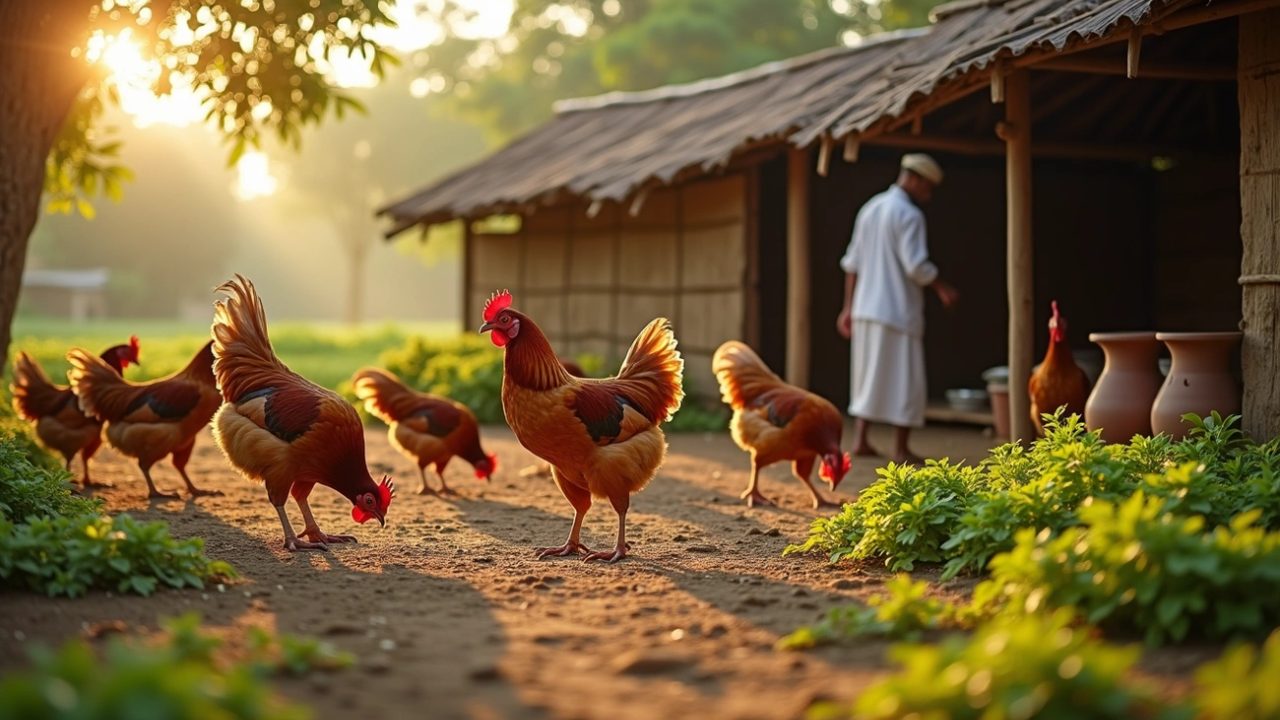
- Low-Cost Startup – Begin your desi poultry farm journey with just ₹50,000–₹2 lakh investment.
- Premium Pricing Advantage – Desi chicken fetches 30–40% higher market rates compared to broilers.
- Dual Income Source – Earn from both organic eggs (100–200 per hen/year) and healthy meat sales.
- Hardy & Profitable Breeds – Raise Kadaknath, Aseel, Gramapriya, Vanaraja – known for immunity & fast returns.
- Sustainable Profits – With 500 birds, farmers can earn ₹2–3 lakh net profit annually in 2–3 cycles.
Starting a desi poultry farm can be one of the most profitable small-scale businesses in India. Desi chickens (also called native or country chickens) are loved for their organic taste, high market demand, and better adaptability to local conditions. With rising consumer preference for chemical-free, protein-rich food, desi chicken farming has become an excellent source of income for beginners and experienced farmers alike.
Understanding Desi Poultry Farming

“India’s poultry sector is worth ₹2.8 lakh crore in 2025, projected to grow 8% annually until 2029.” — BossWallah Editorial Team, Business and agribusiness analysis platform
Native poultry farming is one of India’s oldest farming practices. About 70% of rural households raise indigenous birds across the country. Farmers need minimal involvement as these native chicken breeds have adapted to local conditions over many generations.
What is desi poultry farming?
Desi poultry farming involves raising local chicken breeds naturally with little human help. These birds look for their own food during the day. They eat insects, worms, and leftover kitchen scraps before going back to basic shelters at night. Small-scale farmers can easily start this in their backyards or small plots. This makes it a great option for farmers who don’t have many resources.
Local breeds like Aseel, Kadaknath, Naked Neck, Vanaraja, and Giriraja are naturally tough and resist diseases well. These birds do well in local weather conditions and need very few inputs. This makes them perfect for green farming methods.
Why desi chicken farming is becoming more popular
- Small starting cost – You don’t need much money to begin desi chicken farming. Starting with just two birds works fine, and you can grow your flock over time.
- Better money returns – Though they produce less than commercial breeds, desi chickens sell for more. Farmers can make nearly six lakhs rupees yearly by selling three batches of country chicken.
- Better nutrition – Desi chicken meat has less fat, more omega-3 fatty acids, and important nutrients. This makes it healthier than commercial chicken.
- Strong against diseases – Local breeds naturally fight off common diseases better. Death rates stay under 5% with good care, and they rarely need antibiotics.
- Easy to manage – You can raise these birds in open areas or semi-confined spaces. They use natural shelter and don’t need fancy equipment.
- More buyers want it – Health-aware customers prefer desi chicken because it tastes better and seems healthier. This creates good business chances.
Difference between desi and commercial poultry
- Living space – Desi chickens do best in free-range environments where they can find food naturally. Commercial birds live in closed spaces.
- Time to grow – Local breeds take 22-23 weeks to grow fully. Commercial broilers reach selling weight in just 6-7 weeks.
- Food needs – Desi chickens survive by finding food on their own with some extra grain. Commercial birds must eat special feed their whole life.
- Medicine use – Commercial farms often use antibiotics and growth boosters. Desi chickens rarely need medicine because of their natural strength.
- How much they produce – Regular desi hens lay 80-190 eggs each year. Commercial layers produce over 250 eggs yearly.
- Running costs – Desi poultry costs less to feed and maintain since birds find most of their food themselves.
- Selling price – Desi chicken sells for more (Rs. 350-500/kg) than commercial chicken. This means better profits even with lower production.
| Characteristic | Desi Poultry | Commercial Poultry |
|---|---|---|
| Growth period | 22-23 weeks | 6-7 weeks |
| Adult weight | 3-4 kg | 1.8-2.5 kg |
| Annual egg production | 80-190 eggs | 250-300 eggs |
| Feed conversion | Lower efficiency, natural foraging | High efficiency, controlled diet |
| Disease resistance | High natural immunity | Soft texture, mild flavour |
| Medication need | Minimal | Regular preventive treatments |
| Meat characteristics | Firm texture, rich flavor | Soft texture, mild flavor |
| Market price | Rs. 350-500/kg | Rs. 180-250/kg |
| Carbon footprint | Lower | Higher |
Desi poultry farming keeps getting more popular because it’s sustainable and better for the environment. It also matches what customers want in naturally raised food. Yes, this old practice has become a money-making opportunity for small farmers all over India.
Setting Up Your Desi Poultry Farm

A successful desi poultry farm needs smart planning for land, infrastructure, and equipment. Your first task is to make smart decisions about space needs and shed design that work with your budget while keeping your birds healthy.
Land and space requirements
- Determine space based on farming system: Desi chickens in a deep litter system need about 1.5-2 square feet per bird. Birds in free-range systems need more outdoor space (4-12 square feet per bird).
- Select an appropriate location: Pick a raised area to stop waterlogging and flooding. Your site should be far from residential and industrial zones but have good road access, water supply, and electricity.
- Plan proper orientation: Your poultry house should face east-west to reduce direct sunlight. This setup helps keep temperatures comfortable inside the shed.
- Arrange proper distances between sheds: Multiple sheds need space between them – at least 50-100 feet between chick and grower sheds, and 100 meters minimum between grower and layer sheds.
- Ensure good airflow: Fresh air should flow through brooder sheds first, then move to grower and layer sheds. This air pattern helps keep diseases from spreading.
Low-cost desi poultry farm shed design
- Size your shed appropriately: A 15×20-foot shed works well for 150-300 birds when starting out. The sides should be 6-7 feet high and the centre should reach 10-12 feet.
- Use affordable local materials: Bamboo posts cost ₹30 each and work better than expensive metal poles. Coconut or palmyrah palm leaves make great budget-friendly roofing options instead of asbestos or metal sheets.
- Build a proper foundation: The floor should be 1-1.5 feet above ground level to prevent flooding and moisture issues. A concrete floor with rat-proof features should extend 1.5 feet past the walls.
- Create adequate ventilation: Sheds wider than 25 feet need ridge ventilation at the roof’s centre. Narrower sheds work well with windows on the north and south sides.
- Add essential features: A footbath with disinfectant belongs at the entrance. Strong fencing material (₹18-20 per square foot) protects better against predators than cheap “murgi jali”.
Essential infrastructure and equipment
- Feeding equipment: Linear feeders (₹250-300 each) work best for chicks, while circular hanging feeders (₹500-700) suit adult birds. One circular feeder handles about 30 birds.
- Watering systems: Manual drinkers (₹200-300) serve chicks well at first. Bell-type automatic waterers (₹400-500) make sense as your farm grows. Each bell drinker serves 30 birds.
- Brooding equipment: Chicks need infrared bulbs (150-250 watts) in their first weeks. One bulb warms 150-250 chicks. Brooder guards (1-1.5 feet high) keep chicks close to heat sources.
- Storage facilities: You need separate spaces for feed storage, egg collection, and tools. These should be near the entrance to limit foot traffic around birds.
- Waste management system: A good waste collection system with pits helps create valuable manure you can sell later.
| Equipment Type | Purpose | Approximate Cost (₹) | Quantity Needed |
|---|---|---|---|
| Linear feeders | For chicks | 250-300 each | 1 per 40-50 chicks |
| Circular feeders | For adult birds | 500-700 each | 1 per 30 birds |
| Manual drinkers | Initial watering | 200-300 each | 1 per 50 chicks |
| Bell waterers | Automatic watering | 400-500 each | 1 per 30 birds |
| Infrared bulbs | Brooding | 150-200 each | 1 per 150-250 chicks |
| Brooder guards | Chick protection | 300-400 per set | 1 set per brooder |
| Nesting boxes | Egg laying | 800-1000 per unit | 1 unit per 4-5 birds |

Choosing the Right Breeds and Chicks

Your desi poultry venture’s success depends on choosing the right breeds and healthy chicks. The breeds you select can substantially affect your farm’s productivity, disease resistance, and profits.
Popular desi chicken breeds in India
- Indigenous Pure Breeds – India has four recognised pure indigenous breeds that come with unique traits:
- Aseel: This breed comes from Andhra Pradesh and stands out for its strength, hardiness, and fighting qualities. Males weigh 4-5 kg and females reach 3-4 kg. These dual-purpose birds lay about 80 eggs yearly.
- Kadaknath: This unique breed from Madhya Pradesh has black flesh, skin, and internal organs because of melanin deposits. People prize it for its medicinal properties and high protein content (25.47%), and that’s why Kadaknath meat sells at premium prices. These birds lay around 80 eggs yearly.
- Chittagong: Known also as Malay, these tall, muscular birds have prominent eyebrows and featherless shanks. They lay 70-120 eggs each year.
- Busra: These medium-sized birds from Maharashtra and Gujarat show white and black mixed plumage with yellow shanks and beak. They lay between 40-55 eggs yearly.
- Improved Indigenous Varieties – These breeds mix native hardiness with improved productivity:
- Vanaraja: A multi-colored dual-purpose bird that has attractive plumage, good disease resistance, and adapts well to free-range conditions. The hens lay 160-180 eggs per laying cycle.
- Gramapriya: This layer-type variety works well in rural farming. It lays 230-240 eggs yearly in intensive systems and 160-180 eggs in free-range conditions.
- Srinidhi: This dual-purpose breed grows to 650g at 6 weeks and lays about 228 eggs yearly in intensive systems.
- CARI Developed Varieties – These crossbreeds show improved performance:
- CARI Nirbheek: An Aseel cross that lays 198 eggs yearly while keeping Aseel’s hardiness.
- CARI Shyama: A Kadaknath cross that produces 210 eggs yearly and keeps some of Kadaknath’s unique traits.
How to select healthy desi chicks
- Source verification – Buy chicks from reliable hatcheries that manage their parent stock well. Prominent breeders like Daulat Hatcheries provide various desi varieties with documented traits.
- Physical inspection – Healthy chicks show these signs:
- Clean, shiny feathers with dry beak and nostrils
- Alert, agile, and lively behaviour
- Straight legs and toes without scaly legs
- Same size and colour in the batch
- Age consideration – Seven to 15-day-old chicks give beginners better survival rates than day-old chicks, but they cost more.
- Flock uniformity – A batch should look uniform in size and appearance. This shows consistent health and breeding standards.
- Vaccination status – Make sure chicks have their essential age-appropriate vaccinations.
Desi chicks price and sourcing tips
- Price variations by breed – Each breed comes with its price tag:
- Simple desi chicks: ₹18-25 each
- Vanaraja chicks: ₹18-47 each
- Kadaknath chicks: Premium pricing
- Gramapriya chicks: ₹46 each
- Age factor – Older chicks cost more:
- 0-3-day-old chicks: Base price
- 7-day-old chicks: Cost 20-30% more than newborns
- 15-day-old chicks: Cost 40-50% more than newborns
- Gender considerations – Female chicks, especially from laying breeds, cost more than mixed batches:
- Sonali female-only chicks: ₹32-52 each
- Sonali mixed gender: ₹25-46 each
- Bulk purchase advantages – You’ll find better deals with bulk orders. Many hatcheries can supply up to 20,000 pieces daily.
- Transportation planning – Use ventilated boxes that fit 60 chicks each and protect them from extreme temperatures.
Feeding and Nutrition Management

Nutrition is the backbone of successful desi poultry farming. Feed costs make up 65-70% of total production for broilers and 75-80% for layers. Desi chickens do well with a balanced mix of natural foraging and smart supplementation.
Scavenging vs supplementary feeding
- Understanding scavenging benefits – Desi chickens naturally find insects, worms, seeds, and kitchen scraps while free-ranging. This gives them varied nutrition at no cost.
- Supplementation necessity – Birds can’t get everything they need from scavenging alone. You’ll see better weight gain and meat yield with 75% feed supplementation.
- Timing strategy – Let birds access supplementary feed in the evening for 2-3 hours. This encourages them to scavenge their breakfast.
- Age-based supplementation – Young chicks need extra support: week 1 (10-15g/day), weeks 2-4 (15-25g/day), weeks 5-8 (30-35g/day), growers (30-40g/day), adults (25-30g/day).
Homemade feed mix for different age groups
Chicks (0-8 weeks) need a balanced mix: 22kg maize, 20kg wheat, 24kg pearl millet, 10kg soy DOC, 10kg mustard cake, 8kg groundnut cake, plus small amounts of salt, soda, limestone powder and mineral supplements.
Growers (9-20 weeks) do well with: 18kg maize, 25kg wheat, 25kg pearl millet, 8kg soy DOC, 12kg mustard cake, and essential minerals and vitamins.
Layers thrive on: 16.42kg maize, 25kg wheat, 25kg pearl millet, 8kg soy DOC, 8kg mustard cake, 6kg groundnut cake, with extra calcium from limestone (600g per 100kg).
Azolla and maggot farming for protein
- Azolla cultivation – Build a 6ft×4ft×1.5ft bed using a silpauline sheet. Add 50kg of soil, water, 5-7kg of fresh cow dung, 100g of superphosphate, and 500g of azolla seed culture. Your harvest will be ready in 7-10 days.
- Azolla benefits – This plant packs 24.5% crude protein and boosts growth by a lot when added at 5-10% of the diet.
- Maggot production – Mix cow manure and kitchen waste in open pots. Fill one-third with water. Nature takes care of the rest as flies lay eggs, giving you protein-rich larvae in 5-10 days.
- Combined feeding – Mix 10% each of maggot flour and azolla flour in fermented feed. This matches commercial diets in maintaining egg quality.
Water and mineral requirements
- Clean water access – Birds need fresh, clean water always. Production drops if they go without water for just 6 hours.
- Mineral supplementation – Birds need calcium (3-4%), phosphorus (0.6%), sodium (0.15%), zinc, copper, iodine, and manganese.
- Calcium sources – Layers need shell grit, limestone, or crushed eggshells to make strong shells.
| Feed Ingredient | Protein (%) | Function | Inclusion Rate |
|---|---|---|---|
| Maize/Wheat/Rice | 6-13% | Energy source | 25-35% |
| Soybean/Groundnut cake | 41-45% | Protein source | 8-12% |
| Azolla | 22-24% | Protein supplement | 5-10% |
| Maggot meal | 40-50% | Protein boost | 5-10% |
| Mineral mix | – | Calcium/Phosphorus | 2-3% |
| Rice/Wheat bran | – | Fiber source | 5-10% |
Health and Disease Control

A profitable desi poultry farm needs proper disease management to keep birds healthy. Your farm’s productivity improves when health protocols bring down death rates to less than 5%.
Common diseases in desi poultry
- Viral diseases – Newcastle Disease (Ranikhet) leads to drowsiness, breathing problems, and green diarrhoea. Death rates can reach 100%. Young chicks face Infectious Bursal Disease (Gumboro) with 80-90% deaths.
- Bacterial infections – Birds with Fowl Cholera show diarrhoea and weakness. Infectious Coryza makes their face swell up with discharge from the eyes and nostrils.
- Fungal problems – Birds living in damp conditions with mouldy bedding often get Aspergillosis.
- Parasitic infections – Coccidiosis hits birds between 3-6 weeks. Broilers get bloody diarrhoea and many die. Mites and lice irritate birds and lower their output.
Vaccination schedule for desi hens
- Chicks (0-4 weeks) – Day 1-7: Newcastle Disease (Lasota strain) via eye/nasal drops; Day 12-14: Infectious Bursal Disease via eye drops; Day 22-24: IBD booster via drinking water.
- Growing birds – Week 7: Fowl Pox (0.2ml) via intramuscular injection; Week 9: Deworming; Week 10: R2B (0.5ml) via intramuscular.
- Adult birds – Week 17: Lasota via drinking water; Boosters every 112 days.
Natural remedies and herbal treatments
- Daily prevention – Mix turmeric powder in drinking water. Add garlic or onion to feed to strengthen immunity.
- Parasite control – Bitter medicinal plant leaves (neem, tulsi) help prevent gut parasites. Hang aromatic herb bunches (mint, lavender) in the coop to fight external parasites.
- Natural deworming – Give birds papaya sap, betel nut, or pomegranate peel mixtures.
- Calcium supplementation – Crushed eggshells or lime help prevent deficiencies.
Biosecurity practices for small farms
- Daily cleaning – Clean droppings and old feed from the coop daily. Replace bedding monthly. Clean feeders and waterers thoroughly twice a year.
- Traffic control – Keep visitors away from farm areas. Place footbaths with disinfectant at entrances. Use separate clothes and shoes in poultry areas.
- New bird management – Watch new birds in isolation before they join your flock. Have plans ready to separate birds during disease outbreaks.
- Regular monitoring – Look for signs like tiredness, unusual droppings, sneezing, or injuries daily.
| Disease | Main Symptoms | Prevention | Natural Treatment |
|---|---|---|---|
| Newcastle | Aromatic herbs in the coop | Vaccination at day 5-7, 30, 112 days | Turmeric in water |
| Coccidiosis | Bloody droppings, weakness | Dry litter, proper sanitation | Bitter herbs in feed |
| External parasites | Irritation, feather loss | Coop sanitation | Aromatic herbs in coop |
| Respiratory infections | Coughing, nasal discharge | Good ventilation | Garlic in feed |
| Calcium deficiency | Soft-shelled eggs, weakness | Proper nutrition | Crushed eggshells |
Creating a Profitable Business Plan

“The key areas that will dictate the profitability include production efficiency (yields per bird or egg), appropriate pricing strategies (understanding local markets), and managing high-quality standards regarding welfare & biosecurity.” — Luke Fitzpatrick, Marketing Officer at Drsono
Your desi poultry farm’s financial success depends on a solid business blueprint that looks at both costs and returns. Good planning can help farmers turn a small desi chicken operation into a money-making venture with great profits.
Desi poultry farm business plan essentials
- Market analysis – Learn about local desi chicken and egg needs. Look into your competition and find potential customers like hotels, restaurants, and retail shops.
- Site selection – Pick a spot with good roads, steady water supply, and power. Being close to markets helps cut down transport costs.
- Operational planning – List out your farming methods, what infrastructure you need, and how you’ll manage daily operations.
- Financial projections – Work out your startup costs, running expenses, and expected income from meat and egg sales.
- Risk management – Spot possible problems like disease outbreaks or market changes and create backup plans.
Cost and income estimation
- Original investment – Small-scale farms (1500 birds): Rs. 50,000-1,50,000; Medium-scale: Rs. 1,50,000-3,50,000; Large-scale: Rs. 7,00,000-10,00,000.
- Fixed costs – A 1500-bird farm needs Rs. 93,000 total – Rs. 75,000 for shed construction and Rs. 18,000 for equipment.
- Variable costs – Each batch costs Rs. 1,93,450 total: chicks (Rs. 34,500), feed (Rs. 1,27,500), vaccinations (Rs. 3,200), electricity (Rs. 3,500), labour (Rs. 18,000), and extras (Rs. 6,750).
- Revenue calculation – A 1500-bird farm can earn Rs. 4,01,350 per batch through bird sales (Rs. 3,84,750), eggs (Rs. 15,000), manure (Rs. 850), and gunny bags (Rs. 750).
- Profit potential – You can make Rs. 1,14,900 from your first batch. This goes up to about Rs. 2,00,000 in later batches. Three batches a year could bring in Rs. 6,00,000.
Marketing strategies for local sales
- Build trust relationships – Direct marketing works best when customers trust you because of quality products and honest practices.
- Target premium markets – Highlight features like “organic,” “hormone-free,” or “free-range” to customers who value quality.
- Develop direct channels – Boost profits by selling from your farm, delivering to homes, or supplying local shops.
- Create digital presence – Use social media and online platforms to reach customers directly, especially since the pandemic.
- Strategic collaborations – Build relationships with local restaurants, hotels, and caterers who place regular bulk orders.
How to scale your farm gradually
- Start small – Get experience with a few birds before growing bigger.
- Reinvest profits – Put your earnings back into growing your flock and making your setup better.
- Broaden offerings – Add value with special products like ready-to-cook marinated chicken or custom packaging.
- Improve efficiency – Start making your own feed and find other ways to cut costs.
- Explore integration – Think about making your own feed or adding processing facilities.
| Farm Size | Investment (Rs.) | Birds | Annual Profit Potential (Rs.) | Break-even Period |
|---|---|---|---|---|
| Small | 50,000-1,50,000 | 500-1,500 | 2,00,000-6,00,000 | 6-12 months |
| Medium | 1,50,000-3,50,000 | 1,500-5,000 | 6,00,000-15,00,000 | 12-18 months |
| Large | 7,00,000-10,00,000 | 5,000+ | 15,00,000+ | 18-24 months |
Key Takeaways

Starting a profitable desi poultry farm requires strategic planning, proper breed selection, and understanding market dynamics to maximise returns on investment.
• Start small and scale gradually – Begin with 50-150 birds to gain experience, then reinvest profits to expand your operation systematically.
• Choose hardy indigenous breeds – Select disease-resistant varieties like Vanaraja, Kadaknath, or Gramapriya that command premium prices of Rs. 350-500/kg.
• Implement cost-effective feeding strategies – Combine natural scavenging with 75% supplementary feeding to reduce costs while maintaining optimal nutrition.
• Focus on biosecurity and health management – Maintain proper vaccination schedules and daily cleaning routines to keep mortality rates below 5%.
• Target premium local markets directly – Sell directly to consumers, restaurants, and hotels to maximize profit margins and build lasting customer relationships.
With proper management, a small desi poultry farm can generate Rs. 2-6 lakhs annually, offering one of the most accessible paths to rural entrepreneurship. The key lies in balancing traditional farming wisdom with modern business practices to create a sustainable and profitable venture.
Conclusion
Starting a desi poultry farm is a highly profitable business in India, provided you manage housing, feeding, health, and marketing efficiently. With rising demand for organic chicken and eggs, this venture offers sustainable income and job creation, especially in rural areas. Start small, learn the practices, and gradually expand your farm to maximise profits.
Explore more blogs to boost your farming knowledge and make smarter agri-business moves.
FAQs
It costs around ₹50,000–₹2 lakh, depending on the number of birds and shed size.
Kadaknath, Aseel, Gramapriya, and Vanaraja are highly profitable breeds
On average, 100–200 eggs per hen per year, depending on the breed.
With proper vaccination, mortality can be reduced to 10–15%.
You can earn around ₹90,000 profit per cycle (4–5 months).
They thrive on grains, greens, and kitchen waste, but protein-rich feed improves growth.
Desi chickens take 4–5 months to reach market size.
Yes, it requires low investment and is ideal for small-scale farmers.
Yes, desi chicken meat costs 30–40% higher than broiler chicken.
Absolutely. Many women run small backyard desi poultry farms successfully.