- Low Investment, High Returns – Start with ₹2–2.5 lakh and earn ₹3–5 lakh annually.
- 🐓 Best Breeds to Raise – Kadaknath, Aseel, Giriraja & Vanaraja
- 🥚 Egg Production – 80–200 organic eggs per hen every year.
- Organic & Free-Range Advantage – Sell at premium prices in urban and health-conscious markets
- Booming Demand – Country chicken market in India growing at 15%+ every year.
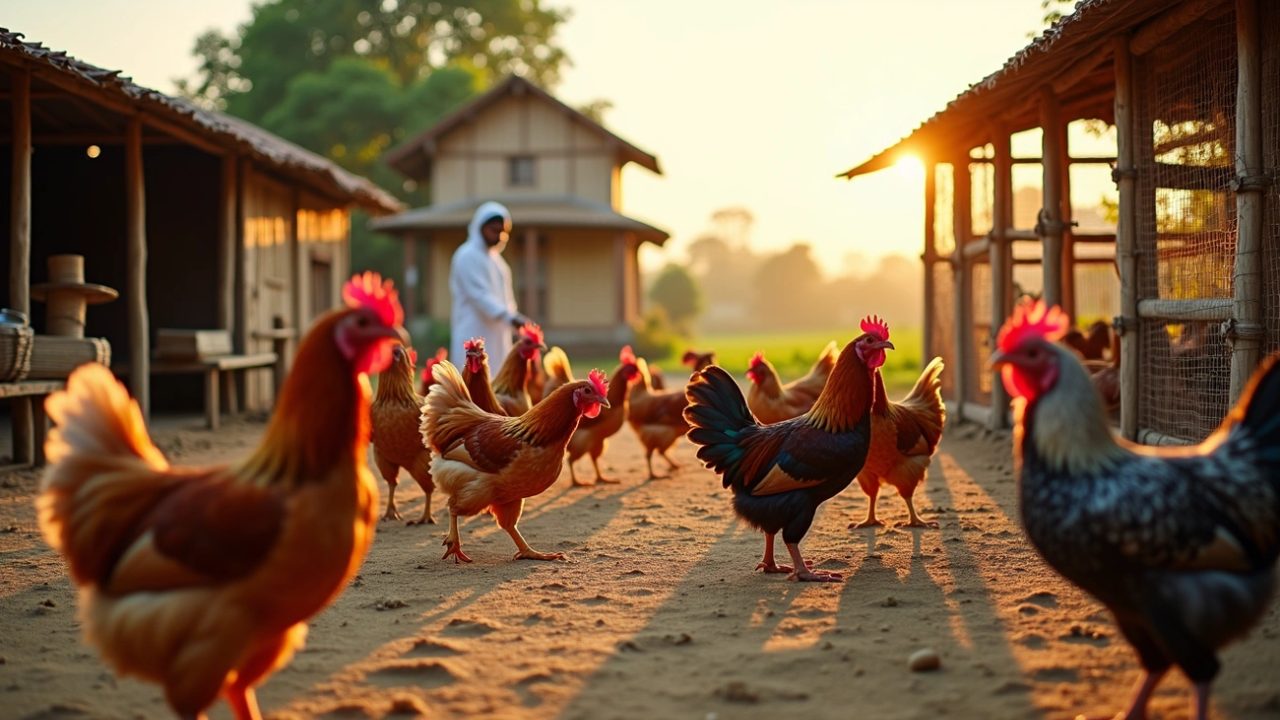
Starting a country chicken farm in India is one of the most profitable and sustainable agribusiness ideas. Country chickens (also called desi chickens or native breeds) are healthier, tastier, and have a huge demand in both rural and urban markets. With rising awareness about organic and chemical-free food, farmers and entrepreneurs are turning towards country chicken farming as a reliable source of income.
Understanding Country Chicken Farming in India

Image Source: Agri Farming
Country chicken farming means raising indigenous chicken breeds that adapt naturally to local Indian conditions. These birds need minimal care compared to industrial poultry, and people love them for their unique taste and nutritional benefits. Rural India has always practised backyard poultry farming, and “desi” chickens remain crucial to village life.
What is country chicken farming?
Starting a country chicken farm involves these simple steps:
- Selection of hardy, local breeds that flourish in regional conditions
- Housing setup – choose backyard, cage system, or deep litter method
- Feeding management – mix foraging with extra feed
- Health monitoring with minimal care
- Natural breeding cycles without artificial methods
These chickens show remarkable resilience and need less care. They thrive in free-range or backyard settings. Kitchen scraps, insects, and grains make up their natural diet, which helps reduce feed expenses.
Indian farmers embrace country chicken farming for several good reasons:
Why is it gaining popularity in India
- Premium pricing – Markets pay more for desi chicken
- Health consciousness – Health-aware customers drive demand
- Low investment requirements – Two birds help you start
- Nutritional superiority – Better nutrition in eggs and meat
- Environmentally responsible – Small carbon footprint, uses kitchen waste
Recent data shows desi chicken farming grew 46% between 2012 and 2019. This growth reflects strong government support and rural economic strength.
Backyard vs commercial desi chicken farming
| Aspect | Backyard Farming | Commercial Farming |
|---|---|---|
| Investment | ₹35,000 (for 100 birds) | ₹1,50,000 (for 1000 birds) |
| Returns | ₹60,000 in 5 months | ₹2,00,000 in 45 days |
| Labor | Minimal (family-based) | More organized labor needs |
| Housing | Night shelters only | Proper sheds/cage systems |
| Feeding | Natural foraging | Balanced commercial feed |
| Scale | 10-20 birds per house | 500-600 birds per hectare |
Backyard farmers let their birds roam free during daylight and secure them in pens at night. Commercial operations prefer cage systems or deep litter methods and provide balanced feed based on growth stages.
Choosing the Right Breed and Setup

The right breeds and housing setup are the foundations of a successful country chicken farm. Let’s look at everything you need to know to make smart choices for your poultry business.
Popular Indian breeds for meat and eggs
- Assess your farming goals – You need to decide if you want to focus on meat, eggs, or both
- Research breed characteristics – Each breed comes with its own traits and output levels
- Select breeds based on local adaptability – Local breeds do better in their native conditions
- Start with proven performers – Begin with well-tested breeds before trying new ones
From India’s 22 registered indigenous poultry breeds, these breeds stand out for commercial farming:
- Aseel: Known for its muscular build and fighting spirit that helped develop modern broilers. This breed gives meat and lays 92 eggs yearly.
- Kadaknath: This unique breed has black plumage, flesh, and organs. People pay premium prices for its meat, which they believe has healing properties.
- Nicobari: This breed thrives in island weather and excels at egg laying.
- Rhode Island Red: These birds lay 250-255 brown eggs yearly, each weighing 53-55g.
- White Leghorn: A favourite among egg farmers with its small, light body and white eggs.
Crossbreeds and their advantages
Mixing different breeds combines their genetic strengths and offers these benefits:
- Improved egg production – Mixed breeding pushed yearly egg production from 91 to 189 eggs
- Better growth rate – Birds convert feed to meat more efficiently
- Stronger disease resistance – You get both local breeds’ toughness and foreign breeds’ productivity
- Weather tolerance – Birds stay hardy while giving better output
To cite an instance, see how mixing Aseel with Dahlem Red boosted egg laying while keeping good traits. Hybrid vigour typically raises egg numbers by 15-23 per cent.
Backyard vs shed vs cage systems
| System | Investment | Advantages | Challenges |
|---|---|---|---|
| Backyard | Lowest | Maximum space efficiency, easier health monitoring, and highest production | Predator exposure, limited control, lower production |
| Shed/Deep litter | Medium | Protected environment, controlled conditions, better biosecurity | Higher original cost, regular maintenance, moderate management |
| Cage | Highest | Maximum space efficiency, easier health monitoring, and the highest production | Welfare concerns, higher investment, intensive management |
Space and climate considerations
- Analyse local climate conditions – Weather changes affect which breed you should pick
- Design appropriate housing – Enclosed houses help you control the environment better
- Ensure proper ventilation – Birds do best with 60-80% relative humidity
- Allocate adequate space – Each chick needs 700 cm² floor space until 8 weeks old
Birds maintain body temperatures between 41°C and 42.2°C, so you must manage their climate carefully. Enclosed chicken houses let you create an “artificial climate” that matches what birds need physically.
| Breed | Annual Egg Production | Egg Weight | Body Weight | Special Characteristics |
|---|---|---|---|---|
| Aseel | 92 eggs | 50g | 4-5kg (cock) | Fighting qualities, high-quality meat |
| Kadaknath | 105 eggs | 49g | Black flesh and bones | Medicinal properties |
| White Leghorn | 300+ eggs | 55g | 2.0-2.7kg | Exceptional egg-laying |
| Rhode Island Red | 250-255 eggs | 53-55g | 2.95-3.85kg | Dual-purpose |
| Gramapriya | 180-200 eggs | Various | – | Low-maintenance |
Step-by-Step Setup Guide for Your Chicken Farm

Image Source: Modern Farmer
Starting a successful country chicken farm needs careful planning and execution. Let’s take a closer look at everything you need to set up your poultry operation from scratch.
1. Planning your chicken farm business plan
Your complete business plan should have:
- Market research – Know the demand for country chicken in your area
- Land requirements – For free-range farming, you’ll need space for 250 adult birds per hectare
- Equipment needs – Make a list of tools and technology you’ll need
- Type of birds – Pick between broilers, layers, or dual-purpose breeds
- Financial projections – You’ll need ₹50,000 (small) to ₹10,00,000 (large) to start
A well-laid-out plan works as your roadmap and helps you get financing if needed.
2. Building the chicken shed or coop
Your chicken housing should have:
- Select an elevated location away from where people live and avoid areas that collect water
- Orient east-west and place ventilation windows facing south and north
- Ensure proper spacing – Give each broiler one square foot and layers two square feet in deep-litter systems
- Choose appropriate materials – Wood makes sense because it’s affordable and easy to find
- Build a proper foundation to stop water seepage and keep rats out
The ideal height should be 6-7 feet at the sides and 10-12 feet at the centre for good airflow.
3. Procuring chicks and initial feed
Starting with your birds:
- Purchase from reliable hatcheries to get healthy stock
- Start with day-old chicks so they adapt better
- Choose appropriate breeds that match your business goals
- Provide balanced nutrition with protein, fats, vitamins, minerals, and carbohydrates
- Feed 40-45 grams daily until chicks reach 8 weeks
Early nutrition substantially affects how well your birds produce later.
4. Setting up water and feeding systems
Your feed and water equipment plays a vital role:
- Install appropriate feeders – You can use automatic, linear, or circular feeders
- Set up watering systems – Bell-type automatic waterers or nipple drinkers work best
- Check water quality – Fresh, clean water is needed daily
- Position equipment correctly – The height should match your bird’s age
- Plan for maintenance – Clean regularly to avoid contamination
Birds need water to regulate their body temperature, especially since they cool down through breathing.
5. Vaccination and health schedule
Your vaccination program should include:
- Day 1 – Marek’s disease vaccine subcutaneously and IB spray
- Day 5 – ND+H9 and ND Lasota
- Day 9 – IBD intermediate
- Weekly monitoring to spot disease symptoms
- Regular deworming and parasite control
Vaccines protect both treated birds and create herd immunity among untreated ones.
6. Record keeping and flock monitoring
Good management needs detailed records:
- Daily production logs – Note egg collection, deaths, and feed use
- Health records – Write down vaccinations, treatments, and what you observe
- Financial ledger – Keep track of money coming in and going out
- Feed consumption data – Work out feed conversion ratios
- Set performance measures using past results
Good records make tax time much easier instead of a last-minute rush.
| Setup Component | Initial Cost (₹) | Required For | Maintenance Frequency |
|---|---|---|---|
| Housing Structure | 1,50,000 | Protection, temperature control | Seasonal |
| Chicks | 40,000 (1000 birds) | Production base | One-time per batch |
| Feeders/Drinkers | 10,000-15,000 | Nutrition delivery | Weekly cleaning |
| Feed (one cycle) | 1,00,000 | Growth and production | Daily monitoring |
| Vaccination | 10,000 | Disease prevention | As per schedule |

Cost, Profit, and Marketing Strategy

Your country chicken farm’s financial health determines its success. Smart planning of costs, returns, and marketing strategies can turn your poultry business into a money-making venture.
Original investment and recurring costs
You need careful financial planning to start your country chicken farm:
- Assess scale requirements – Small-scale farms need ₹50,000-₹2,00,000 while large operations need ₹10-15 lakhs
- Calculate infrastructure costs – Housing structures cost around ₹1,50,000 for sheds, feeders, and drinkers
- Budget for initial stock – You’ll spend about ₹40 per chick (₹40,000 for 1,000 birds)
- Prepare for feed expenses – Feed makes up about 70% of total costs
- Allocate for healthcare – Set aside ₹10,000 for medicines and vaccines
A 1,000-bird setup needs about ₹3.5-4 lakhs as a starting investment.
Expected returns from meat and eggs
Your farming model decides how much you earn:
- Broiler returns – Each bird sells for ₹150-₹200 after 6-8 weeks
- Calculate batch revenues – 1,000 birds can bring in ₹1,50,000-₹2,00,000 per cycle
- Layer profits – 1,500 chickens can earn between ₹50,000-₹1,00,000
- Analyse annual egg production – One layer produces around 300 eggs annually
- Compute total potential – 1,500 hens laying 290 eggs each gives you about 4,35,000 eggs yearly
Good farm management leads to profits within six months if you control costs well.
How to market your poultry products
Build a resilient marketing strategy:
- Research local demand – Know what the market wants before you start
- Set appropriate pricing – Add your desired profit margin to production costs
- Emphasise product uniqueness – Show how your product stands out from store-bought chicken
- Create multiple revenue streams – Make money from meat, eggs, and by-products like manure
- Monitor price fluctuations – Keep track of supply and demand changes by season
Avoiding middlemen and selling direct
Direct marketing boosts your profits:
- Establish direct customer relationships – Deal with consumers directly to control prices better
- Think about delivery options – Give customers convenient pickup spots or home delivery
- Package professionally – Transport products in styrofoam coolers with ice packs
- Build reputation – Add business cards to orders for more referrals
- Get necessary permits – You’ll need a Food Establishment Permit and proper storage facilities
Farmers who sell directly make more money while keeping quality high.
Government schemes and subsidies
Make use of available financial help:
- Apply for National Livestock Mission – Get 50% capital subsidy up to ₹25 lakhs
- Explore interest subvention – Up to 3% on loans for poultry projects
- Use SIDBI channels – You get a subsidy in two equal instalments through SIDBI
- Check state-specific incentives – Some states don’t charge electricity duty and stamp duty
- Utilise combined schemes – NLM can cut your ₹50 lakhs project cost to ₹25 lakhs
| Farm Scale | Initial Investment | Expected Returns | Payback Period | BCR at 15% DF |
|---|---|---|---|---|
| Small (100 birds) | ₹14,000 | ₹67,500-₹81,000/year | 6 months | 1.24:1 |
| Medium (1,000 birds) | ₹3.5-4 lakhs | ₹1.5-2 lakhs/cycle | 2-3 cycles | 4.17:1 |
| Large (1,500 birds) | ₹7-10 lakhs | ₹20-28 lakhs/year | 6-12 months | >50% IRR |
Key Takeaways
Starting a country chicken farm in India offers excellent profit potential with proper planning and execution. Here are the essential insights for aspiring poultry entrepreneurs:
• Start small and scale gradually – Begin with 100-1000 birds requiring ₹50,000-₹4 lakhs investment, achieving profitability within 6 months through careful management.
• Choose indigenous breeds for premium pricing – Desi chickens like Kadaknath and Aseel command higher market prices due to superior taste and nutritional value.
• Leverage government subsidies effectively – National Livestock Mission offers 50% capital subsidy up to ₹25 lakhs, potentially halving your initial investment costs.
• Focus on direct marketing to maximise profits – Bypass middlemen by selling directly to consumers, emphasising your product’s unique qualities over commercial alternatives.
• Maintain detailed records for success – Track daily production, health schedules, and financial data to optimise performance and ensure sustainable growth.
With India’s poultry market growing at 6-8% annually and reaching ₹1905.3 billion in 2022, country chicken farming represents a sustainable path to rural entrepreneurship that preserves indigenous breeds while generating substantial returns.
Conclusion
Starting a country chicken farm in India is a smart agribusiness idea that ensures steady income, low investment, and huge demand. From choosing the right breed to marketing, every step plays a vital role in success. With proper planning, care, and smart marketing, you can easily earn ₹3–5 lakh annually from a medium-scale farm.
Explore more blogs to boost your farming knowledge and make smarter agri-business moves.
Frequently Asked Questions (FAQs)
Around ₹2–2.5 lakh for 500 birds.
Kadaknath, Aseel, Giriraja, and Vanaraja.
Between 80 to 200 eggs, depending on the breed.
Yes, profit margins are higher than in broiler farming due to premium pricing.
₹800–₹1000 per kg live weight.
No, they grow well on natural feed, but supplements improve productivity.
4–6 months for maturity.
Yes, NABARD and state governments provide subsidies up to 25–33%.
Around 100–150 sq. ft. in intensive farming.
Yes, it’s best suited for villages due to low-cost feed and open land.